
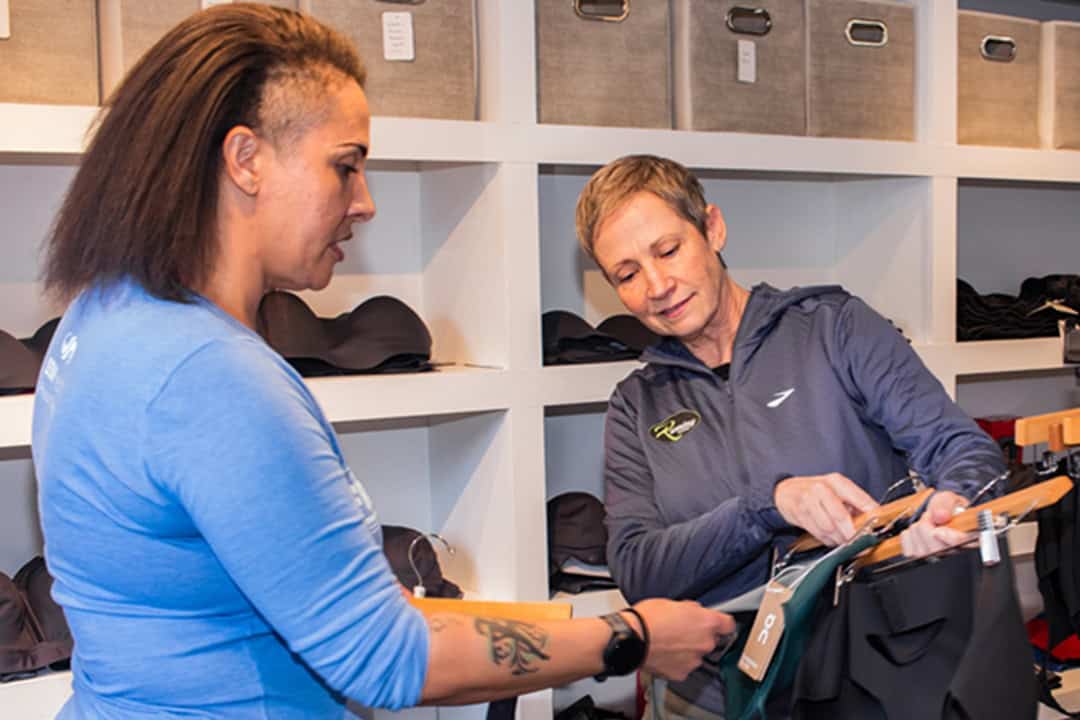
When Bob Dyer first talked about starting Running Niche, his wife and co-owner, Jennifer Henderson, had just one condition. “I wouldn’t open a store unless we had a good bra selection,” she says. “I wanted to include more women in fitness.”
He agreed, knowing that the proper bra is as essential as the proper shoe. The running motion causes breasts to move up and down, left and right, which can strain connective tissue and lead to soreness and poor running form.
So, Running Niche devotes a separate room to its array of bras from brands like Brooks, Anita, and Enell. Band sizes range from 32 to 53, cup sizes from A to K.
Choosing the best one, Henderson says, is a balancing act. Runners want to be able to breathe freely without bouncing or chafing.
Manufacturers and designers achieve control in two ways: compression and encapsulation.
Compression pulls the breast closer to the body. Encapsulating isolates each breast and fully wraps it to minimize both side-to-side and up-and-down movement. Many models combine the two.
“Compression alone is good for smaller sizes, but encapsulation is of primary importance for almost everyone,” Henderson says.
Finding the right bra can be a partial DIY project. Henderson starts by asking the following questions:
- Can you close a clasp behind your back, or do you close it in the front and twirl it around? If it’s the latter, avoid racerback styles.
- Do you want to wear a shirt over the bra? Some styles, especially for smaller runners, are designed to be worn without a shirt.
- And most important: What size are you?
Lynn Rinker, a massage therapist, has benefited from this support — so to speak. When she started running again about six years ago, she visited Running Niche and discovered she had been wearing the wrong size bra. Rinker is not alone; the National Institutes of Health shared research showing that 80% of women wear the wrong size.

Running Niche has an extensive bra selection. (Kathleen Nelson)
“The right fit made a huge difference,” Rinker says. “Running became so much more comfortable.”
To find your correct fit, start by measuring yourself. First, wrap a tape measure around your ribs where the lower bra band hits, and use the first chart in the sidebar to determine your band size. For the cup size, measure around the fullest part of your bust. Subtract the rib cage measurement (not the band size) from the bust measurement, then refer to the second chart.
Next, try on a few bras to verify the measurements. If you’re willing to try on shoes at a store, why not bras? “Running Niche won’t pressure you to buy anything,” Rinker says. “I come here first to get information and their opinion.”
Among the issues she’s discussed with Henderson: How many bras? (If you run six days a week and wash twice, you need three.) How to clean them? (Wash on a gentle cycle; line dry.) When to replace? (If chafing becomes an issue, it’s a sign the fabric is breaking down.)
Running bras can be pricey — $40 to $120 each — so Henderson will point to online resources if cost is an issue. “I don’t want a bra to be a barrier to running,” she says.
***
About the Fit
Use these guides to determine your size.
Rib Cage Measurement Band Size
25”-27” 30
27”-29” 32
29”-31” 34
31”-33” 36
33”-35” 38
35”-37” 40
37”-39” 42
39”-41” 44
Bust Measurement Minus Rib Cage Measurement Cup Size
3” AA
4” A
5” B
6” C
7” D
8” DD
9” E
10” F
Sources: REI, Brooks Running
Author: Kathleen Nelson is a frequent contributor to Terrain.
Top image: Lynn Rinker (left) discusses bra options with Jennifer Henderson, co-owner of Running Niche, in the store’s bra room. (Kathleen Nelson)
Leave A Comment