
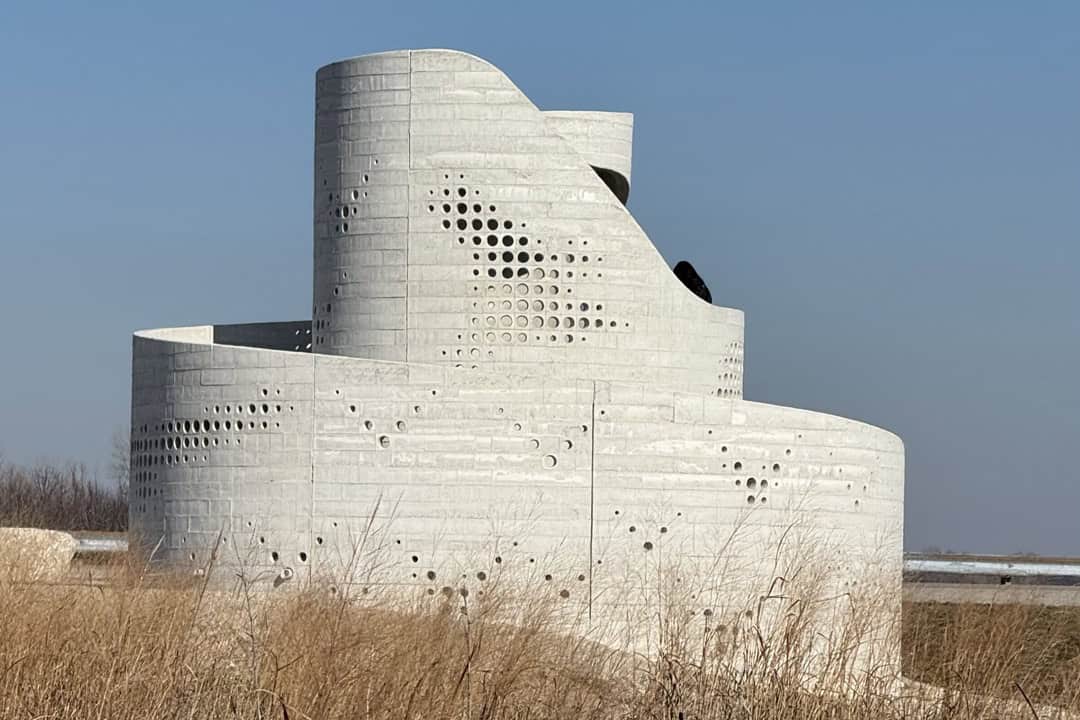
Avis Spiralis, the newest bird blind at Audubon Center at Riverlands, has exactly 293 viewing portals as it spirals 20 feet high above Heron Pond. I know this because my daughter, Maeve, and I counted every one of them on a chilly but sunny weekend afternoon in early January.
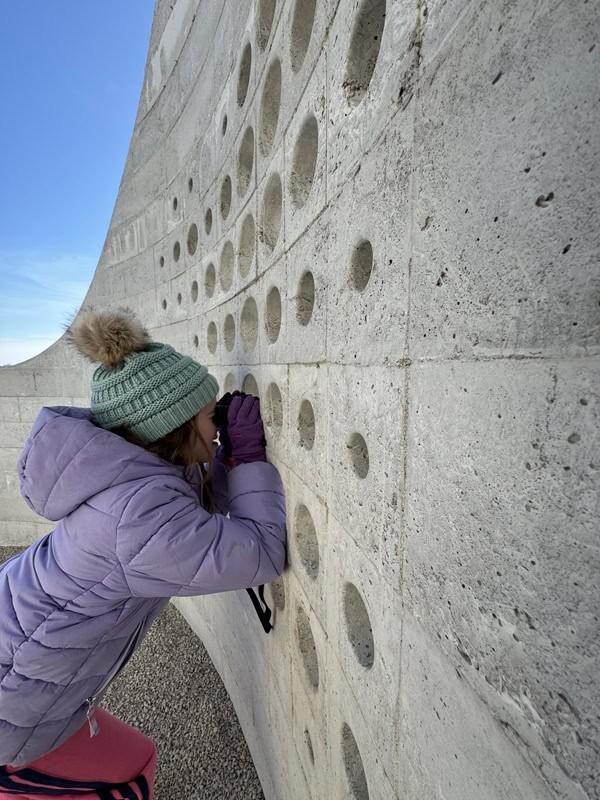
I asked Maeve which portal was her favorite. She paused for a moment, then lowered herself to one of the smallest openings below her typical seven-year-old eye level. It was the same one she had immediately looked through after charging up the pathway, the fine white gravel scrunching under her freshly tied shoes.
“My little secret one right here, because I think usually nobody looks through it,” she told me. “All the tiny ones — usually the big people don’t look through those ones.”
Ken Buchholz, the executive director of Riverlands, appreciated this story.
“I love that,” he says with a laugh. “You can look through the openings whether you’re three-foot tall or six-foot-five. There’s something for everyone. And you can also, at a certain height, look over the blind’s wall and get a fuller view of Riverlands.”
These portals, which come in four sizes and evoke visions of birds in flight, are the most striking feature of the flood- and fireproof concrete structure designed by Pablo Moyano Fernández, an associate professor of architecture at Washington University.
The gravel used in the concrete was sourced from a nearby quarry, while the river sand for the concoction came from the Missouri River. The blind was constructed by Moyano Fernández, with a bit of help from his students at WashU’s Sam Fox School of Design & Visual Arts.
The location of Avis Spiralis, or “spiral bird,” which opened last fall, is intentional.
Riverlands is situated in West Alton, Missouri, in the heart of the Mississippi Flyway migration route, a few miles from the confluence of the Mississippi and Missouri rivers. The blind was carefully placed between the edge of Heron Pond — an expanse of vital prairie marshland — and the open-water Alton Slough off the Mississippi.
Visitors looking east toward the river can see trumpeter swans, bald eagles, ospreys, ducks, geese, and other birds that prefer open water. Swing around and point the binoculars to the west, and they’ll see a different realm with herons, rails, songbirds, and other secretive-type avians — along with reclusive mammals, reptiles, and amphibians — that prefer the cover provided by the marsh vegetation.
Seasoned birders arrive near dusk or dawn, hoping to catch sight of a northern harrier or short-eared owl flying low over the marsh, listening for a noisy vole or rabbit that might be plucked for a meal.
“There are a lot of really cool birds that come through here in spring and fall migration,” Buchholz says. “Sixty percent of North American birds are migrating up and down the Mississippi River, so when you have a habitat that’s so well maintained and varied, right at the heart of that flyway, that’s why there are so many birds at Riverlands.”
Avis Spiralis is the second bird blind overlooking the marshlands, joining the Heron Pond Observatory on the other end of Heron Pond. Buchholz loves the design, which takes on a different shape depending on the angle from which a person looks at it.
He thinks the blind resembles a nautilus shell spiraling up. As Maeve and I walked back to the blind after a short hike down a trail, I asked for her description.
“I think it looks like an eagle,” she said. “The bottom part looks like the body of an eagle. The top part looks like the head, and then the part sticking out kind of looks like its beak, because the bottom of it is pointy like an eagle’s beak.”
This seemed like a perfect explanation to me.
For more information, visit here.