
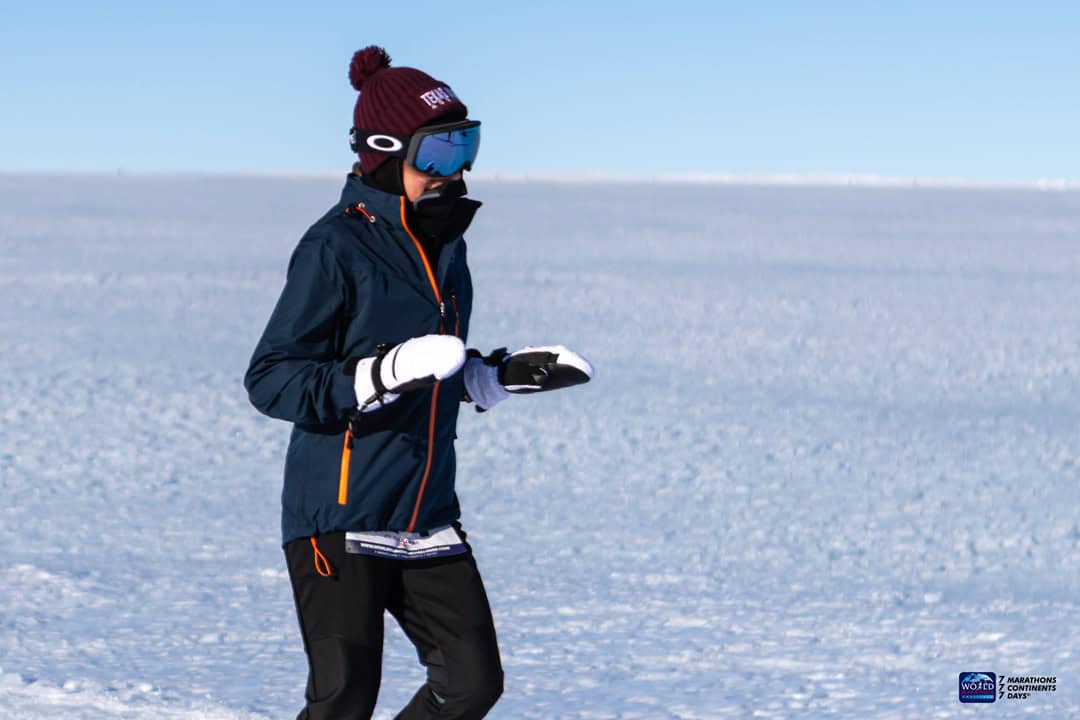
Julie Kulawiec was flying blind — in a cargo jet with no windows. The crew turned off the heat an hour before landing so she and 60 other passengers could acclimate and dress. After landing, they donned goggles, “so we wouldn’t damage our corneas.”
The doors opened at Ultima Base, Antarctica.
“The vastness was beautiful, though the wind was wicked,” says Kulawiec (pronounced KOOL-uh-wek) of St. Charles, Missouri. “Then, I realized how few people experience this.”
That step off the plane January 31 was the first of the 14th marathon of her career. Over the next six days, she ran marathons 15 to 20, each part of the 777 World Marathon Challenge, organized annually by Runbuk. The company manages most of the logistics to complete seven marathons on seven continents in seven days. The $50,000 fee, however, does not include transportation to the meet-up in Cape Town, South Africa, or the return flight after the final marathon in Miami.

Kulawiec finishes the 2026 Australia Intercontinental Marathon as part of the 777 World Marathon Challenge. (World Marathon Challenge/Runbuk)
Kulawiec, 61, averaged a little over six hours per marathon, which illustrates her keenest insight: “If I can do this, anyone can. When you put your mind to something and try hard, you can achieve it.”
She was introduced to running in a class at Eastern Illinois University and ran “a few miles here and there” through nursing school. She completed her first marathon in 1998, “but I didn’t train much. I figured I could do better if I trained.” She entered one or two marathons a year with a goal of qualifying for the Boston Marathon, which she ran in 2003.
The 777 World Marathon Challenge didn’t show up on her radar until about a year ago. Her first thought was, “No way. How can you do that?’” But she was curious enough to check out the website and mention it to her husband, Keith. “He said I was insane, that I would injure myself and never be able to run again. But it kept coming up on my feed, so I requested more information.”
The deal was sealed when she learned that about half of the participants ran for charities. As a former oncology nurse and board member of the local Susan G. Komen Foundation, raising money to fight breast cancer convinced her and Keith that she needed to enter.
Though she says she “wasn’t good at asking for money,” she raised enough from friends, family, colleagues, and her employer to cover the entry and donate $11,400 to Komen. Lululemon donated gear, which she needed for the other six stops, building memories while testing her resilience.
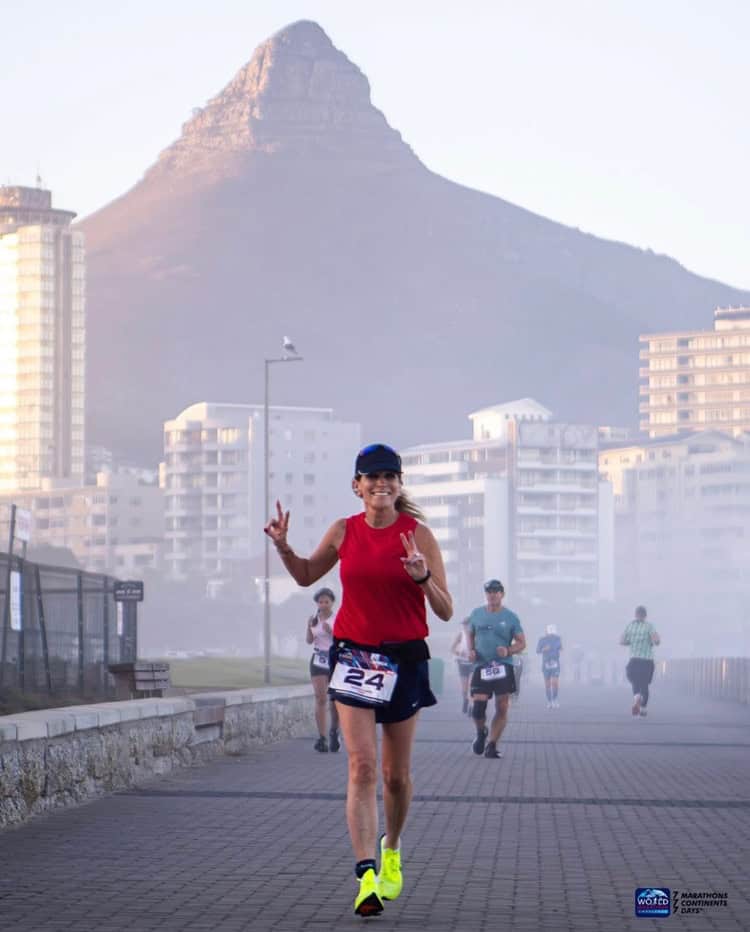
Cape Town is the location of the Africa Intercontinental Marathon, the second of the 777 World Marathon Challenge. (World Marathon Challenge/Runbuk))
Africa (Cape Town): “The weather was perfect for running, and there’s such diversity among the people there.”
Australia (Perth): “It was 107 degrees, the hardest race. We did four laps, passing women with sponges to cool us. They’d ask, ‘Would you like the hose?’ then, ‘We’ll see you in a bit, love.’”
Asia (Dubai, UAE): “Probably my favorite. Men couldn’t run shirtless. Women had to cover their sports bras. There were an interesting combination of people: some in Chanel, others in traditional Muslim clothing.”
Europe (Madrid): “Cloudy and rainy. We ran 11 laps on a Formula 1 track, which was kind of numbing.”
South America (Fortaleza, Brazil): “It poured. We ran to our ankles in water. It was pitch black for most of the race.”
North America (Miami): “We started at 11:30 p.m. on a Thursday, and it was freezing. My family was there, though, which was exciting.”
Her next race might be in Europe. Or, she says, “I know someone doing an ultramarathon. I asked how she could take on something so hard. She laughed at me. ‘You just did,’ she said.”
Kulawiec trained for four and a half months for the 777 World Marathon Challenge, using her knowledge from 13 marathons and the wisdom of runners who had completed the challenge. Among the most helpful tips:
- Work up to four-hour runs on Saturday AND Sunday.
- Spend four to five days a week on biking and core training: “They said don’t overrun or you’re likely to injure yourself beforehand. I think they were right.” Her worst injury was a blister on her foot that “felt better three miles into the next race.”
- Run in sand. It’s the best way to replicate the feeling of the Arctic snow beneath your feet.
- Train at different times of day. Some of the races are at night, and the frequent time zone changes mean your body clock won’t be in synch with local time.
- Bring shoes a size bigger because your feet swell. Hers never did.
Author: Kathleen Nelson is a regular contributor to Terrain Magazine.
Top Image: Julie Kulawiec running in the Antarctica Intercontinental Marathon as part of the 777 World Marathon Challenge. (World Marathon Challenge/Runbuk)
Leave A Comment