

When I launched my freelance writing career, I needed something to do that wasn’t sitting in my office staring at my computer waiting for editors to respond to my pitches. So I rucked — that is, I went for walks with a weighted backpack.
Desperate for assignments, I saw a way to take advantage of my new hobby. I pitched stories about hiking and landed a whole mess of them. Hiking became backpacking became bike riding became adventure races became endurance events became triathlons.
Rucking changed my life. And it will change your life, too, once you’re done studying Rucking 101.
It’s accessible. “Anyone can do it,” says Danielle, a resident doctor who helps lead St. Louis Ruck Women, and who is devoted to getting women outside. “People are always like, ‘Wait, you can’t lift that. That’s too heavy. You’re going to hurt yourself.’ And I’m like, ‘No, I’ve been training for this. Our bodies are designed to do this.”
You need zero experience to ruck. You don’t need a gym membership or special training. You barely even need gear. All you need is a ruck (a term that can mean the act itself and the pack you wear while doing it) and stuff to cram in it.
How much stuff? You decide based on your age, weight, and fitness level. “My advice is to talk to your doctor before beginning rucking and to start with a low weight,” says Danielle, who uses rucking to stay in shape for outdoor adventures. “It doesn’t matter what the number is. It’s all about what is hard for you.”
Rucking will be as cheap or as expensive as you want it to be. When I started, my “weight” was canned food, books, and small dumbbells. After several years of that, I bought a high-end ruck and a 30-pound weight plate, but I only got them because a magazine reimbursed me for the cost. If not, I might still be toting around SpaghettiOs and tattered copies of Harry Potter.
(Matt Crossman)
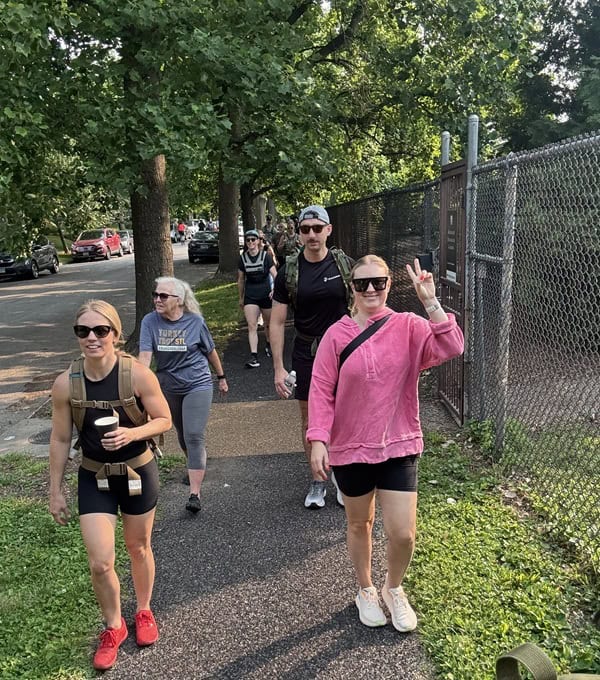
It’s relational. I often ruck in groups with rollicking conversations that would be impossible in group runs or bike rides. Look at the photos with this story. Selfies, all big smiles, all glistening in sweat. There’s magic in that. Being outside and working hard loosens the tongue and opens the ears. It’s not just that you’re having conversations, it’s that you’re having good conversations, fueled by endorphins, sweat, and caffeine — as all good rucks involve coffee.
Or should, at least.
“A lot of times after you’ve just done a workout like that, you have a little bit clearer head, you can think about some things,” says William Swofford, the co-owner of CrossFit Ready 2 Live gym in St. Louis. “You breathe well, and you can talk about what matters to you the most.”
Swofford started a coffee-and-ruck program that he intended to be just him and a friend. He opened it up through his gym, and 25 people showed up to ruck to and from a coffee joint. He turned it into a regularly scheduled event.
It’s flexible. Rucking is versatile both in the benefits it provides (strength, endurance, cardio) and in who gets those benefits. People of all fitness levels can do it together. “You can come with zero weight and just walk,” Swofford says. “And we get people that are upping it to 50, 60, even 100 pounds.”
Rucking entered the fitness culture from the military. My most frequent rucking companion is a colonel in the Missouri Air Force National Guard, and many big events, including Go Ruck overnight rucks and 22 Strong (a 22-mile ruck held every September), have strong military ties.
The military loves rucking because it builds a solid fitness base from which you can take your fitness wherever you want. That’s why I love it, too, and the same goes for Danielle and Swofford, a Navy veteran.
Sometimes I ruck at a leisurely pace with light weight. Sometimes I carry more and go faster. And sometimes the ruck is the mode of transportation in a circuit workout. Assuming it has good handles, a ruck is ideal for curls, overhead presses, thrusters, and more.

(Matt Crossman)
It’s functional. Everyone has to carry heavy stuff at some point. Even Danielle, a resident at Barnes, has had literal applications of her rucking experience when she lugs blood transfusion containers across the hospital.
“That thing is so heavy,” she says, “And I’m like, ‘Wow, I’m so glad I’ve been rucking, because I feel like this would be really difficult if I hadn’t been training.”
It’s practical. I brainstorm story ideas during rucks, and if I’m stuck on a piece, a ruck lets me clear my mind. I jot down ideas in a notebook I carry in my pocket, or I peck out an email on my phone and send it to myself.
“I’m a software engineer by trade, so there’s a lot of times I’ll be stuck on a problem or not be able to figure something out,” Swofford says. “I’ll grab the ruck, and it does clear the mind, like, oh, there’s the problem…I fixed it. You separate yourself from the problem, and you can see it clearly.”
No, really, it’s practical. I made up a word, “exer-errands,” that combines exercise and errands. Two houses ago, my bank was the perfect rucking distance away. Once a week or so, I strapped on weight, loaded my wallet with uncashed checks, rucked to the bank, deposited them, and rucked home. And for years, I have cut the grass with my ruck on.
Danielle occasionally rucks to the grocery store, to work, and one day last winter, she rucked around the hospital. “I do look ridiculous,” she says with a laugh. “But you know what? I’m also trying to fit exercise into my busy schedule.”
***
CARRY ON
A few rucking events in the St. Louis area.
Chubb Trail Races
March 28
Eureka, Mo.
In the all-new 25k ruck category, participants must carry at least 20 pounds (not including food and water) for the duration.
The Spring Sprung
May 2
Ballwin, Mo.
The top three male and female finishers in the 10k ruck division get podium awards. Carry 20 or 30 pounds.
Do Hard Things
September 12
Columbia, Mo.
Proceeds from this 9.11-mile ruck benefit Veterans Community Project, providing homes and services to veterans in need.
Honoring Our Heroes Marathon
November 21
Salem to Rolla, Mo.
This military-friendly event features ruck divisions in all its races: 5k, 10k, relay, half-marathon, and marathon.
Author: Matt Crossman is a contributor to Terrain. To sign up for his free newsletter, go here.
Top image: Courtesy of Matt Crossman.
Leave A Comment