

“Hey, how do you paddle around here?”
Go ahead and ask someone this simple question in the Ozarks, and they might stare at you for a moment before deadpanning a simple answer.
“With a boat.”
Now, that’s the Ozarks I love. After spending enough time down there, many outdoorsy people come to love it, too. It just takes a bit to figure out the region — both the one-liners and the paddling.
Currently, the Ozarks are having a moment. This seems to be happening despite the remote region doing pretty much everything possible to avoid attention. The rivers are plentiful but remain fairly hidden, and understanding seasons, flows, access, and logistics can be tricky. The lettered roads feel like riding a disorienting roller coaster that went off the rails. During the leafy summers, impenetrable Ozark forests become Jurassic Park-like refuges for snakes, ticks, and poison ivy.
Oh, and Netflix spent millions on cautionary propaganda — by which I mean the TV series Ozark. Even the producers must have been too afraid to go to the real Ozarks, because they filmed outside of Atlanta.
Luckily, Ozark rivers are a refuge for fun, especially during the sweltering months of summer. Most of these rivers are safe and scenic places to paddle, with tons of beginner-friendly options. Here are some ideas to get you started paddling in the Ozarks.
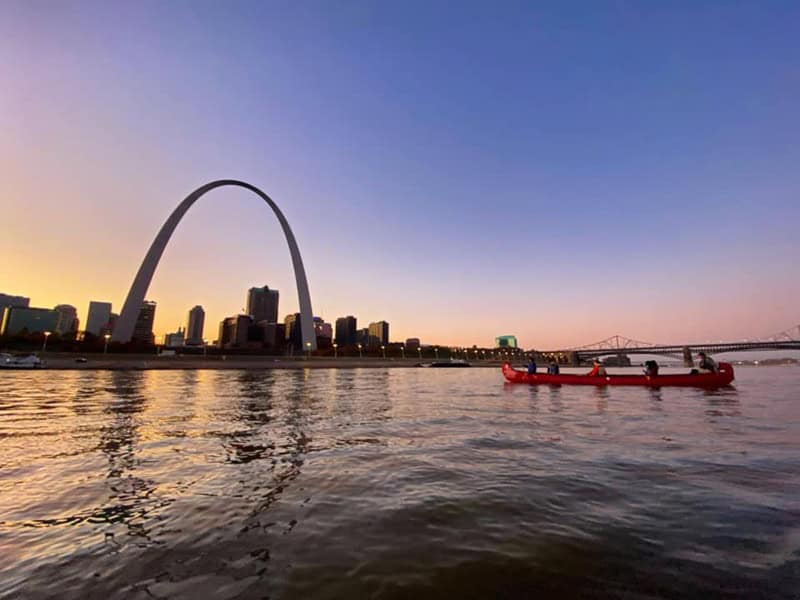
Big Muddy Adventures offers guided trips on the Mississippi River. (Big Muddy Adventures)
Learn How to Paddle
They say, teach a person how to paddle, and they’ll have fun for a lifetime. Give them a canoe or kayak without instruction, and they’ll flip it immediately, quit after day one, and then someone else will buy that lightly used boat at a huge discount. This definitely happens. Check Facebook Marketplace, Craigslist, etc.
The way to avoid a quick crashout is to learn some basic skills. Luckily, St. Louis and the nearby Ozarks are among the best regions in the country for learning to paddle. One way to start is by joining a guided paddling trip, which typically includes some basic instruction.
Around St. Louis, Big Muddy Adventures has earned a solid reputation for popular trips on the Mississippi and Missouri rivers. Plus, they manage boat rentals and activities at a few lakes around the metro region, including Creve Coeur Lake, Simpson Lake, and Post-Dispatch Lake in Forest Park.
Another option is to take a paddling class. The St. Louis Canoe & Kayak Club offers clinics for both members and nonmembers. Missouri State Parks offers a Learn 2 Paddle series at several locations within striking distance, including Cuivre River State Park, Meramec State Park, and Current River State Park.
Once you feel comfortable on the water, typically after a few trips, you can head for the Ozarks and rent boats from local outfitters.

The Meramec is a good river for beginners and families. (Barbara Ostmann)
Best Rivers for Beginners and Families
When you’re starting out as a paddler, set yourself up for success by progressing gradually. One option is to spend some time on a calm lake or in a slow-moving pool on a river, staying near the shore. Practice the paddle strokes you learned from an instructor before tackling faster currents.
In a controlled setting, you might even practice dumping, aka flipping your boat and swimming it to shore. For reasons like this, most beginners prefer to paddle during warm or hot weather, from late spring to early fall.
When it comes to paddling downstream, consider starting on a shorter section of river, around three to five miles long, with a relatively gentle but steady current. With a slower or longer section, you might tire yourself out paddling through flat water. With a faster river, you risk flipping your boat or being swept into dangerous strainers.
(A strainer is any submerged in-channel obstacle — such as downed trees, branches, or rocks — that water passes through but could trap a swimmer. Always avoid strainers and avoid putting your feet down in deep or fast water, where lurking branches or rocks can cause dangerous foot entrapments. Instead, keep your entire body near the surface and swim aggressively, on an obstacle-free path, toward shore.)
Around St. Louis, one of the best places for beginner paddlers is the Meramec River in the northern Ozarks. The five-mile section from Sappington Bridge to Meramec River State Park has a mellow current, scenic bluffs, swimming holes, and gravel bars to stretch your legs. The park concessionaire offers boat rentals that include a shuttle to the launch site.
This stretch of the Meramec River is also a great choice for families. Parents will have to decide for themselves when their kids have reached the right age to start paddling. Things to consider include not only the child’s swimming ability but also their ability to follow instructions and stay engaged with the activity while on the water.
In general, parents of younger children should already be experienced paddlers themselves before they assume responsibility for taking their kids on the water. Once the decision is made, the most successful paddling parents typically guide their beginner child through a gradual progression that combines lessons, guided trips, lake practice, and easier rivers like the Meramec.

The Pulltite Cabin near the Current River is worth a look. (Mike Bezemek)
Best Rivers for Intermediate Paddling
As your skills progress, you can take your watery adventures in more challenging directions. This can include several objectives: paddling faster currents and longer trips, taking two vehicles and running your own shuttle, venturing out during cooler seasons like spring and fall (and eventually winter), and seeking out remote rivers in wilderness settings.
Many Ozark rivers meet these intermediate criteria, and several of the best options are managed by the National Park Service. One excellent choice is the Current River, located about 150 miles southwest of St. Louis within Ozark National Scenic Riverways. The Current has swift, cool, spring-fed waters and is particularly well suited for paddling in the upper reaches, where motorboats aren’t allowed.
A good first trip on the Current River is the nine-mile section from Pulltite Campground to Round Spring. This run combines low bluffs and scenic woodlands with an optional stop midway to walk to the historic Pulltite Cabin. At the take-out, tours of Round Spring Cave are typically possible, though they’re currently suspended pending replacement of a footbridge.
Throughout the park, there are numerous other access points and runs to explore on both the bigger Current River and the smaller Jacks Fork. The latter tributary has fewer springs and a lower average flow, so it’s more popular in spring or after heavy rains that raise the level.
The park service maintains a helpful list of authorized outfitters for shuttles and boat rentals. Exploring Ozark National Scenic Riverways is a great way to build your skills and confidence before venturing further into the adventurous southern Ozarks.
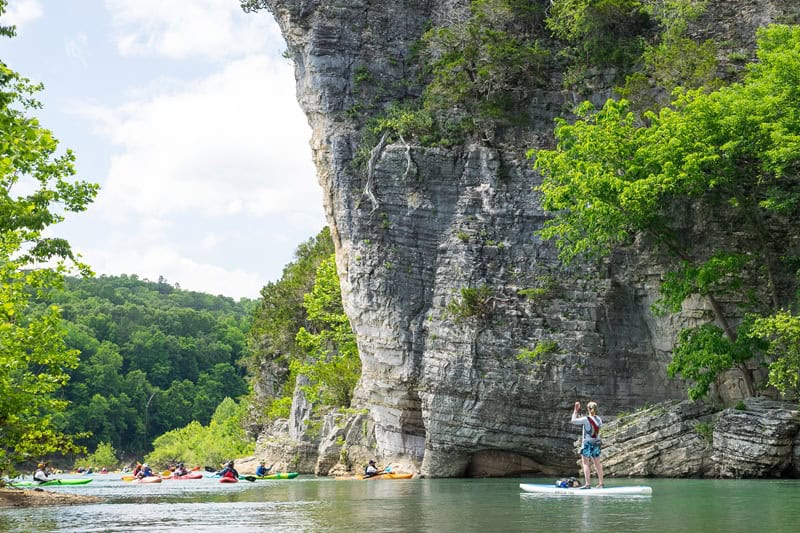
The Buffalo National River is lined with scenic limestone bluffs. (Mike Bezemek)
Best River for Scenery and Wildlife
The Buffalo National River in northern Arkansas is widely regarded as the most impressive overall paddling destination in the Ozarks. It’s a commitment to paddle here, with a five-hour, 300-mile drive southwest from St. Louis, but it’s worth the effort.
The Buffalo River runs for about 150 miles through the Ozarks’ most rugged and highest region, the Boston Mountains. The entire river is managed by the National Park Service. While paddling is the highlight, there’s also camping, hiking, and historic sites to explore. The scenery is top-notch, with many sections lined by sheer limestone bluffs. The river is also known for its wildlife, with opportunities to spot elk, bald eagles, and river otters. Fishing is popular, with anglers primarily targeting smallmouth bass.
In general, the upper sections are more challenging, with steeper gradients and lower average flows, so the prime season is spring. Passing through the park’s Ponca Wilderness, the section from Ponca to Kyles Landing is an Ozark gem, running 10.5 miles in length. The silvery cliffs of Roark Bluff are iconic. Side hikes lead up to Big Bluff and to Hemmed-in Hollow, home of the tallest waterfall between the Rockies and Appalachians at 209 feet.
Other great paddling sections can be found on the middle and lower Buffalo, with the flows increasing and the current slowing as you move downstream. This makes the scenic, slow, nine-mile section from Dillards Ferry to Rush Landing a good choice for summer trips. Beyond Rush, the river enters the Lower Buffalo Wilderness Area, which is an excellent multiday adventure for experienced paddlers.

The Niangua River is a legendary party scene. (Mike Bezemek)
Best Party Floats
“Hey, what do you drink around here?”
Go ahead and ask someone this loaded question on an Ozark river, and they might say the following.
“Everything except for water.”
Certain Ozark rivers have a bit of a reputation for — how do I say this delicately? — “liveliness.” Usually, it’s good-natured. Sometimes, it becomes a drunken mess. In general, bringing a cooler with canned beers is part of Ozark floating culture. Whatever you choose to bring, always remember to carry out your trash. Don’t be like some Ozark partiers, who scatter theirs across the river.
Several river trips are particularly known for having a party vibe. Near St. Louis, one example is the six-mile section of the Huzzah Creek from Westover Road to Huzzah Valley Resort. Further west, the Niangua River is a legendary scene around Bennett Spring State Park. Further south, in Arkansas, the Spring River is the rare class II float, with a series of fun ledge rapids that tend to dump partiers.
If you want to have fun but avoid the sketchy side of the on-river party, schedule summer trips for midweek or launch on weekend mornings.
If you want to witness the notorious Ozark party scene like some kind of tipsy anthropologist, you can blend in by doing the following: Launch roughly midday. Don’t even bother paddling, just float in circles, bumping into overhanging tree branches and getting snagged in shallows. Beach yourself on every gravel bar until you’re cooked to a crisp on one side of your body. Sunburning your front side means you were semi-conscious the entire day. Congratulations. Burning your backside suggests a story not worth bragging about. Reach takeout around dark, stumble through the wrong campsite, receive a visit from the park ranger, etcetera, etcetera.
All joking aside, my friends and I have repeatedly administered first aid to drunken Ozark floaters. Several times, these injured inebriates had to go to the hospital. Don’t be one of them. Stay in control. Have fun. Be safe.

The St. Francis River is no place for newbies. (Mike Bezemek)
Best River for Whitewater
Speaking of safety, inexperienced and drunk floaters are more likely to get hurt on a river than experienced whitewater paddlers, who learn to respect the power of rivers. While the region doesn’t have the same level of whitewater as the Southeast or Mountain West, the Ozarks have some surprisingly fun rapids, mostly in the class II to III range. One of the best places for beginner and intermediate whitewater paddling is the St. Francis River, near Fredericktown, Missouri, about 90 miles south of St. Louis.
There are two sections on what regional paddlers call “the Saint.” The upper section is easier, offering about three miles of class II to II+. The lower section passes through Tiemann Shut-ins, a small granite gorge famous for rapids in the class II+ to III range that become harder at higher water levels. This is not the type of river to show up on with an aluminum canoe or sit-on-top kayak. The Saint is for serious paddlers who wear helmets and paddle specialty whitewater boats.
Becoming a whitewater paddler may sound daunting, but the best way to embark on this thrilling adventure is to seek out instruction. It just so happens that the St. Louis-based Missouri Whitewater Association offers an excellent line-up of learning opportunities, including beginner pool sessions and an on-river clinic held each spring on the Saint. Learn more here. While developing your skills on the Saint, you’ll learn about other whitewater gems hidden in shut-ins across the Ozarks.

There’s so much to explore in the Ozarks — like this stretch of the Buffalo River. (Mike Bezemek)
The Best River Is the One You’re Paddling
Whether you’re seeking beginner ideas or advanced goals, there’s plenty more paddling to discover throughout the Ozarks.
If you’re looking for more options, please check out my guidebook Paddling the Ozarks, which shares details on over 40 of the region’s best paddling trips. Keep at it, and you’ll find even more.
Eventually, you’ll be the experienced Ozark paddler people come to for information. Someday, you’ll be at a gas station with boats on your vehicle’s roof, out where a numbered highway meets a lettered road. A curious traveler will approach you with a question.
“Hey, where do you paddle around here?”
“The rivers,” you’ll deadpan before going on to mention a few options.
Because now you know the surprising truth. There’s way more to paddle in the Ozarks than you could ever explain.
Author: Mike Bezemek is the author of Paddling the Ozarks and a frequent contributor to Terrain.
Top image: A paddler navigates the middle Buffalo National River. (Mike Bezemek)
Leave A Comment