
If you didn’t already know, you would have no idea what you were looking for, nor what you might find once you arrive.
First, you search for a trapezoidal building labeled “12” in the old Lemp Brewery complex, triangulated between Cherokee Street, Lemp Avenue, and South Broadway in south St. Louis.
From there, look for the green double doors on the ground floor. You’re getting closer. You cross the threshold, hang a left, and head up the stairs for the second floor.
Once at the top, keep walking across the industrial wooden floor to the first open door on the left, which ushers in another world.
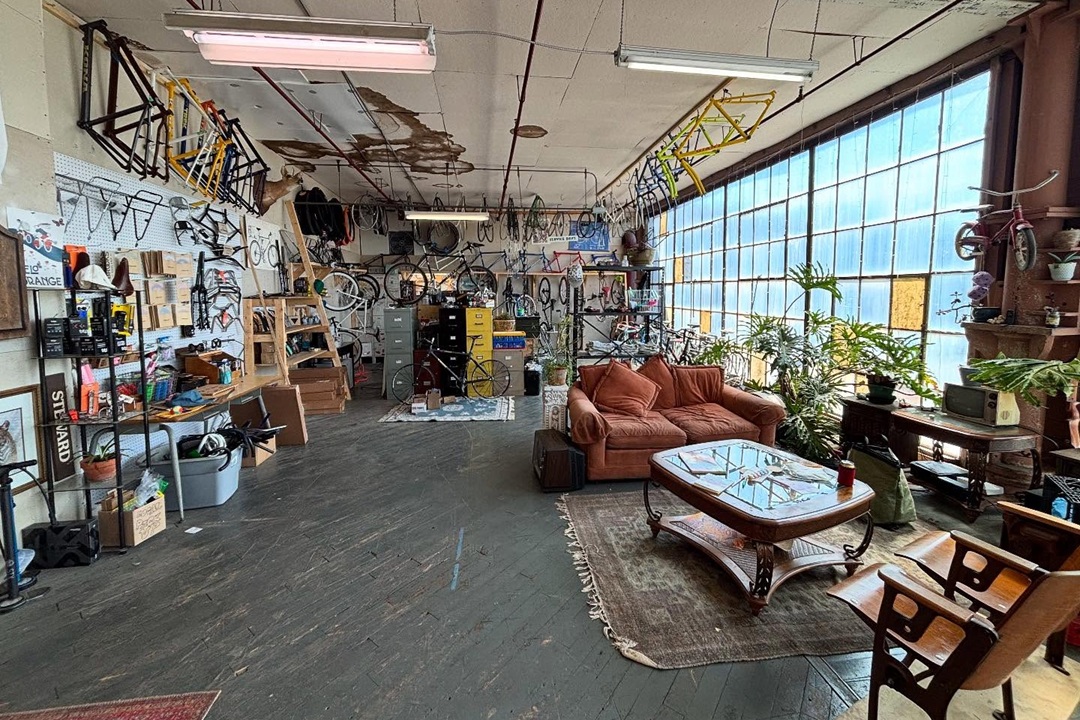
The space is immediately welcoming with a couch, chairs, and plants placed in front of a wall of windows overlooking the former brewery.
Used bikes line another wall, and bike frames ready to be reborn adorn the ceiling. There’s a small mechanics workshop on one side and a commercial sewing machine on the other.
Welcome to the home of Hobo Hub Works and South City Stitchworks.
What started as independent basement hobbies for friends Matt Steward, an eco-conscious bike mechanic, and Zach Smith, a former schoolteacher and bikepacking hobbyist, transformed into something much bigger in the fall of 2024 when they decided to team up on this unique space.
Since then, it has become a well-known secret among bike enthusiasts and those seeking a comfortable space to hang out with like-minded people.

Zach Smith (left) and Matt Steward. (Steve Petersen)
Hobo Hub Works
If you’re looking for a bike that has more character and charm than those you’d find at your neighborhood bike shop, Hobo Hub Works is the place to go.
Owner Matt Steward spent years working in different bike shops around the country — building, selling, and repairing bikes straight from the factory — but became disillusioned with the industry and its predominant message that “new is always better.”
“Loads of bikes are trashed each year because the industry tells us we need the next best thing and our old bikes are outdated,” Steward says. His solution? Start upcycling used bikes by adding new parts and parts salvaged from other cycles.
Most of Steward’s creations are built around the steel or chromoly frames of bikes from the ’80s and ’90s. The metal frames from this era are more durable and versatile, making it easier to swap parts to customize the “new” bikes into whatever a customer wants.
The end results usually look great, with fun, colorful paint jobs, featuring a mix of cargo cages and racks for everyday use.
“I feel like I’m just doing what I love and what I dream about — making community my goal,” Steward says.
“I’ll sweat or be frigid in a warehouse to keep a community strong and get more butts on bikes. I just want to provide the best service to folks and be a welcoming space for all people, whether they’re new to cycling or long-time riders, no matter their background.”

A Specialized Hardrock mountain bike restored by Hobo Hub Works. (Courtesy of Hobo Hub Works)
South City Stitchworks
Initially, Zach Smith began making colorful, heavy-duty bags for bikepacking as a side hustle because the other products he had used during his own bike adventures left something to be desired.
But a demand for his craftwork began to grow.
A few years on, and his bags have graced the podiums of some of the most epic bikepacking ultra races in the world.
These include the Silk Road Mountain Race (Kyrgyzstan), Atlas Mountain Race (Morocco), Tour Divide (Canada to New Mexico), Baja Divide (California to Mexico), and Ozark Gravel Doom (Arkansas).
This is a testament to Smith’s dedication and craftsmanship.
“It’s been amazing to see my gear at the finish line of some of the world’s most prestigious bikepacking races,” says Smith. “And I love receiving photos from my customers with their rigs on these adventures they’ve been planning for years.”

Zach Smith in his South City Stitchworks shop. (Steve Petersen)
What makes Smith the happiest, though, is when people buy South City Stitchworks gear as gifts for loved ones.
“It’s a huge honor to think something I make is worthy of being something people are proud to give to the folks most important to them,” says Smith.
South City Stitchworks began as a solo operation, and Smith plans to keep it that way.
“Ideally, it will always be just me, a craftsman who people can work one-on-one with to make the gear of their dreams,” says Smith.
“They may have to wait a while to get it, but I’ll guarantee it for life because I made it with my own hands.”
Author: Kyle Wayne Stewart is a frequent contributor to Terrain.
Top image: The Hobo Hub Works shop and hangout space. (Courtesy of Hobo Hub Works)
Leave A Comment