
One of the joys of strolling through a city park is encountering a ridiculous number of massive trees.
When I walk through Tower Grove Park with my dog — which I do about five times a week — I peer up at some of these leafy, thick-trunked giants and think, “Man, where am I, Yosemite?”
It’s a good feeling, but it’s not one you’re likely to experience on the north side of St. Louis (aka North City).
Up there, high-quality trees are hard to find, especially since the tornado swept through in May and destroyed literally thousands of them. (O’Fallon Park alone lost over 480.)
As Chris Geden of River City Outdoors told me, “In North City, there weren’t that many trees to begin with. Now there are even less.”
Statistics on sites like Tree Equity Score back up this claim.
For example, while the South City neighborhood of Shaw earns a tree equity score of 100 (out of 100) with a tree canopy rating of 31% (meaning 31% of the space is covered by trees), the North City neighborhood of Fairground scores a 63 and 13%, respectively.
North City neighborhoods like The Ville, Vandeventer, and Hyde Park earn similarly poor marks.
This is far from ideal because trees, although often taken for granted, offer a wide range of benefits.
To name a few: They improve air quality by absorbing pollutants and releasing oxygen; they boost water quality by reducing storm runoff; they provide shade and cool the air around them; they beautify a neighborhood, leading to higher property values and more profitable businesses; they reduce stress and promote concentration, improving mental well-being; and they encourage people to get outdoors and be more active, reducing obesity and other health problems.
On top of all this, tree-filled neighborhoods are associated with lower rates of crime and vandalism.
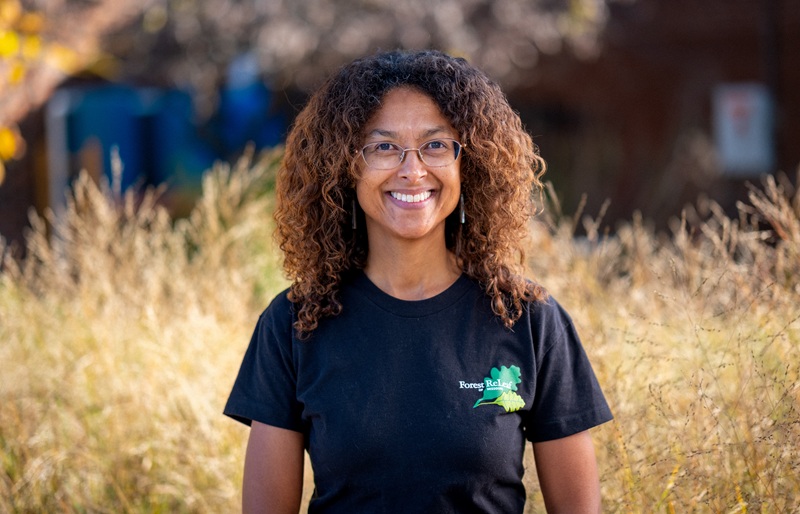
“Trees are awesome,” says Rebecca Hankins, a partnership manager at the Missouri nonprofit Forest ReLeaf. “We’re drawn to them as human beings. They calm our minds. Trees are so vital for a healthy, livable community.”
Tree Love
Forest ReLeaf is not new to the tree game. Since 1993, the group has given away over 260,000 trees in Missouri, including over 65,000 in the St. Louis metro area.
But it’s only been in the past four years that Forest ReLeaf has actively tried to improve what Hankins calls the “low tree-canopy status” in North City.
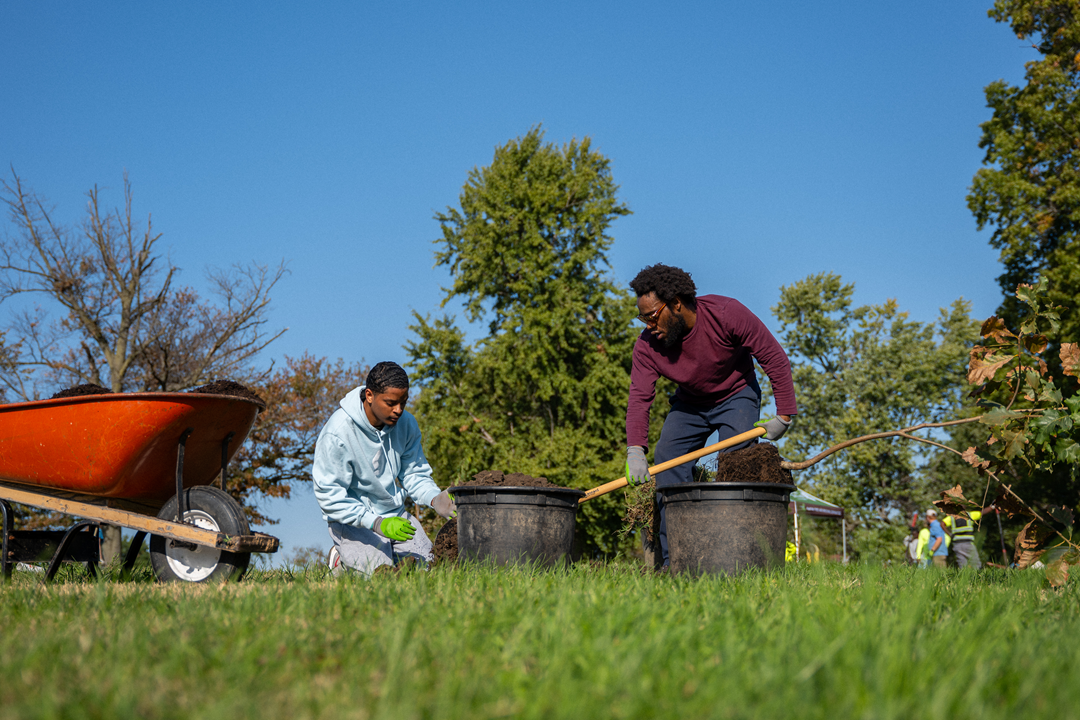
To this end, they have planted more than 1,100 Missouri native trees — oaks, redbuds, bald cypresses, and tulip trees — in North City parks since 2021.
“At this point, we have planted in every North City park except O’Fallon,” says Hankins. “And that’s going to change next spring.”
But it’s not just about planting. Forest ReLeaf has also made a commitment to stewarding the trees it plants.
That means watering the trees during their first two years of life (when they are most vulnerable to death by mower, drought, and stress) and monitoring them for a third year.
Hankins calls this stewardship piece “a game-changer.” Their tree survival rate is 92%.
In addition to their work in parks, Forest ReLeaf has also recently partnered with the city’s forestry division and others on a couple of major projects.
First, they’re involved with the Trick or Tree drive, which mobilizes children across the region to collect donations while trick or treating this Halloween.
All funds will directly support tree-replanting efforts in tornado-impacted neighborhoods in north St. Louis. (For more information on this program, go here.)

Forest ReLeaf also recently partnered with the city’s forestry division to plant 3,200 trees on residential streets in under-resourced areas, most of which are in North City.
These trees are being planted in the tree lawn (or tree well) of a residence: the city-owned space between the sidewalk and the street.
While most residents are embracing these new trees, some are resisting — a sentiment that Hankins says she understands.
Trees, after all, can be costly to remove and pose a risk of falling during a storm, potentially damaging property.
“If residents don’t want the tree, they can opt out,” she says. “We want to have conversations and address concerns. We want people to feel good about trees.”
For more information about Forest ReLeaf or to volunteer, go here.
Author: Shawn Donnelly is the managing editor of Terrain.
Top image: Forest ReLeaf volunteers plant a tree in North City’s Hyde Park. (Sean Garcia)