

It was a typical bike commute for St. Louis resident Dave Fiedler.
The 43-year-old nonprofit executive was taking his usual route home from work, which includes part of South Lindbergh Boulevard. As he crossed Gravois Road, a driver suddenly turned into a car dealership and directly into Fiedler’s path. The driver didn’t see him.
The car struck Fiedler’s rear wheel, throwing him off the bike and wedging it under the car. Fiedler somersaulted and landed on the shoulder of the road. He broke the tibia and fibula bones in his right leg, dislocated a finger, and suffered numerous scrapes.
Fiedler had surgery on his leg and was in the hospital for three days. Fortunately, he recovered completely and has no long-term pain or mobility issues (the accident occurred in 2015).
Ky Katzman also had a dangerous run-in with a driver who didn’t see him. While waiting at a red light at Hampton Road near I-44, the 48-year-old band manager carefully proceeded through the intersection when the light turned green.
A driver exiting the highway ran through the stoplight and hit Katzman’s front wheel, dragging him to the ground. Bleeding and shaken, Katzman made his way to the nearby Drury Inn parking lot with the driver. Though police responded, no citation was issued.
“The police officer didn’t understand the law that a pedestrian or cyclist has the right of way, and the driver failed to yield at a crosswalk,” Katzman says.
Crashes like these are far too common in the St. Louis region and statewide. According to a 2024 study by the League of American Bicyclists, Missouri ranks 49th out of 50 states for bicycle-friendly practices and 32nd out of 50 for biker fatalities.
Informed cyclists know the drill: stay alert, wear bright clothing, and use lights (see the sidebar for more tips on keeping safe). But isn’t there more that can be done to keep bike riders, pedestrians, and drivers safe?
Dangerous Trends
With distracted driving and speeding on the rise, many cyclists report feeling less safe on the roads. The data paints a complicated picture.
Nationwide, the number of bicycle accidents is declining, but fatal crashes are increasing. The National Safety Council reports that preventable deaths from bicycle incidents rose 53% from 2014 to 2023, while nonfatal injuries dropped 29%.
A 2024 crash report from Trailnet, a nonprofit organization that promotes walking, biking, and transit in the St. Louis area, shows a similar trend.
In St. Louis County, bike accidents with injuries increased from 60 in 2023 to 83 in 2024 — 81% of which occurred where no bike lanes or trails exist. In St. Louis City, injury crashes increased slightly from 49 to 52.
The most sobering data: While the total number of car crashes involving cyclists and pedestrians has decreased 35% since 2010, fatalities have risen sharply.
In 2010, there were 17 pedestrian or cyclist deaths in the City and County combined; in 2024, there were 59 pedestrian or cyclist deaths. Today’s crashes are fewer, but more deadly.
Multiple factors contribute to crashes, but “high speeds on overly wide arterial roads with inadequate pedestrian crossings, and a lack of bike facilities, continue to be an extremely dangerous combination in St. Louis,” states Trailnet’s report, which is based on data from the Missouri State Highway Patrol.
Erich Hellmer, Trailnet’s community planning manager, notes that safety concerns are changing behavior: “It’s hard to get data on how many people are walking and biking daily, but one report shows that from 2019 to 2022, 47% fewer people were walking and biking. I’d argue that it’s because people feel less safe.”
Designing for Safety
For years, the St. Louis region has introduced features designed to improve pedestrian and cyclist safety. These include traffic calming methods such as roundabouts and bump-outs (also known as curb extensions), as well as protected bike lanes and high-visibility crosswalks.
“Traffic calming features aren’t the most popular thing, because people don’t want to slow down, but we’ve seen a huge improvement [where they’re installed],” Hellmer says.
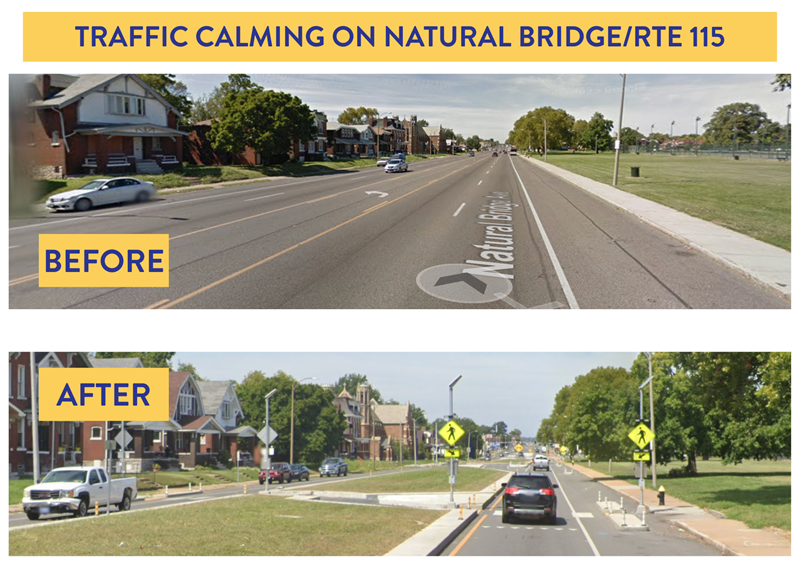
One example: The Missouri Department of Transportation added traffic calming features to a two-mile stretch of Natural Bridge Road in 2022 and saw a 79% decrease in crashes of all kinds. “Everybody is safer, including drivers,” Hellmer says.
In contrast, a recent project on Clarkson Road in west St. Louis County saw bump-outs removed after public backlash. (Residents were upset they were not notified of the bump-outs prior to their installation.) Still, other features remain in place and are working, Hellmer says.
“We know people hate traffic calming, but these are proven methods. You can’t argue it’s not working. If you see trees or curbs that make a road feel more narrow, people slow down. All the plans coming out in our region are well informed and make it better for pedestrians and cyclists,” Hellmer says.
Trailnet CEO Cindy Mense urges the public to embrace the changes. “People want roads to be safer, but safety and speed are opposites,” she says. “You can’t have a fast road and make it safe for pedestrians. We need people to understand how slowing down a little bit makes it safer for everyone.”

On the Road Again
Cyclists like Fiedler and Katzman know all too well how hurried drivers can ruin a bike ride. But despite their traumatic experiences, both are back in the saddle.
“People said I was probably done [after the accident],” says Fiedler. “But I said no. The risk is always present, but it’s outweighed by the joy and benefits cycling brings.”
Katzman agrees. He has had a couple of close calls since his crash in 2019, including another car running a red light. “Even if you’re doing everything right [as a cyclist], you can get hit,” he says. “With cell phones, so many people are not paying attention.”
Missouri’s new hands-free law, which went into effect on January 1, prohibits drivers from holding phones, texting, or scrolling while driving.
While enforcement is still being ramped up, advocates hope it will reduce distracted driving incidents. Preliminary data from Cambridge Mobile Telematics shows the law has reduced distracted driving in Missouri by 5.1%.
Still, Katzman now rides more alertly. “I’m a good driver and thought everyone else was too. I trusted too much,” he says. “Now, I make sure the person sees me, and I use a bike cam to get a shot of their license plate, just in case.”
***
Stay Safe
Becoming complacent while cycling can be dangerous. Here are key tips to protect yourself.
Dress for success. Wear a helmet, bright clothing, and reflective gear, and make sure your bike has reflectors and lights.
Think ahead. Choose a lane position before reaching an intersection to avoid conflict with other traffic.
Ride predictably. Don’t weave in and out of traffic. Ride in a straight line and avoid sudden swerving.
Obey traffic laws. Stop at all stop signs and red lights, even if it looks like no one is coming.
Stay single file. Avoid side-by-side riding and conversations that distract.
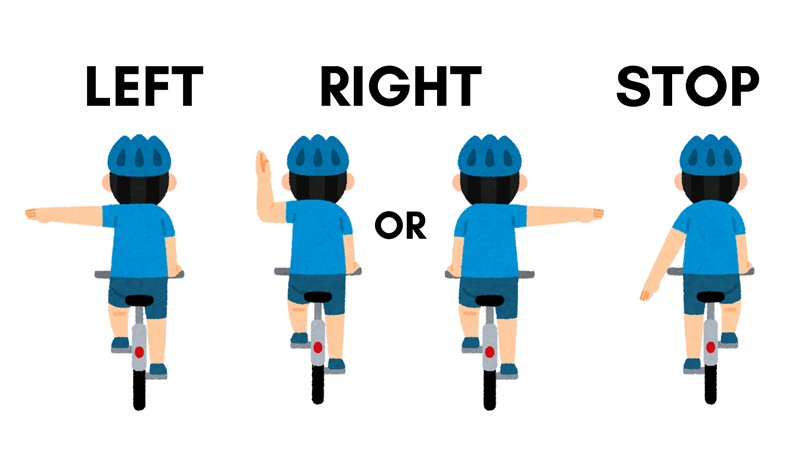
Use hand signals. Let drivers and other bicyclists know your next move (see the image above). Make eye contact. Never assume drivers will stop.
Stay focused. Distractions could get you killed. Don’t use your cell phone or earbuds/headphones while biking.
Take a class. Local resources like CyclingSavvy, Trailnet, and St. Louis BWorks offer safety courses and workshops for all ages, as do some bike shops. Check their websites for details.
Author: Terri Waters is a contributor to Terrain.
Top image: iStock.