
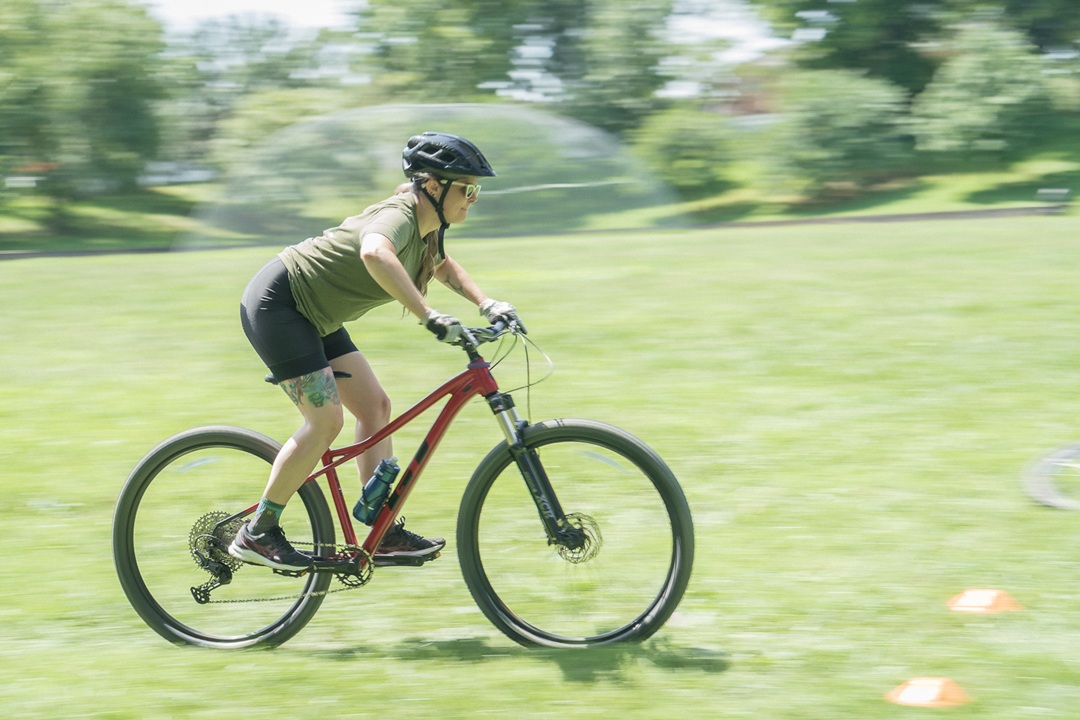
I must still be traumatized by middle school in the early 2000s, when everyone was terrified of being labeled a “poser” — because the butterflies in my stomach were doing cartwheels when we pulled into Crestwood Park in St. Louis County on a recent Sunday.
I had never ridden my mountain bike on anything but gravel, and I hadn’t ridden it at all since getting pregnant three years earlier. All the questions that plague the socially anxious were running through my head: “What if I’m not advanced enough for this course? What if my bike is too basic? What if I can’t keep up?”
Getting Acquainted
Within minutes, I would be attending a clinic through Wheels Up MTB. The clinic’s terrifying name: “Level One Skills Clinic: Foundations of Mountain Biking for Adults.”
Typically, when you attend a Wheels Up program, you pull up to find team tents, airbags, and obstacle setups. But Level One is stripped down to focus on education. In fact, when I arrived, I wasn’t even sure I was in the right parking lot. (Where was the trailhead?)
I approached a truck parked in the grass.
I learned that the truck belonged to Cody Jones, the owner and founder of Wheels Up, and our instructor for the day. With more than 22 years of teaching experience, Jones clearly understood the importance of creating a comfortable environment before putting students in the saddle.
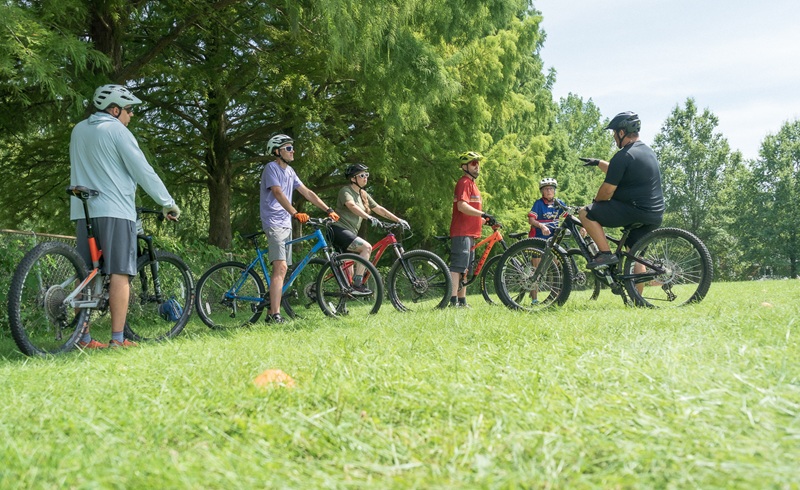
After everyone arrived, Jones scanned his five students and began with a question: “Why are you here?”
One by one, my fellow classmates answered.
“I want to spend more time outdoors.”
“I want to avoid getting hurt.”
“I want to ride harder trails.”
“I want to ride with my kids.”
Then it came to me: “It looks like a ton of fun,” I said. “And I want in.”
I’m 37, and my classmates ranged from 30-something to 70-something. As with our ages, our experience levels varied widely. One person said they had just recently bought a bike. Another said they were riding all the time but wanted to up their game.
Jones assured us that, despite our differences, we were all in the right spot.
Lesson, Practice, Repeat
Instead of a bike park, our classroom was a flat grassy field marked with a few bright orange disc cones. I breathed a sigh of relief.
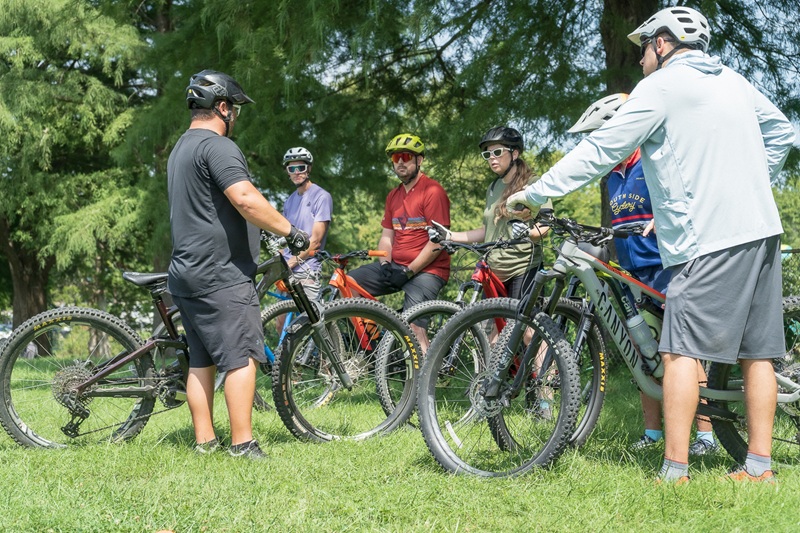
Jones explained the first foundational skill in the lesson: how to position our pedals when not actively pedaling. After explaining, he demonstrated and answered our questions. Then, we each tried.
We rode to the top of the circuit, built a little cruising speed, and practiced the skill in front of Jones for his feedback. We would each practice the skill a few times, trying to get progressively better with each lap. Then, we were called to line up again for another mini lecture.
And we repeated the process: lesson, demonstration, questions, practice, and feedback. Except, each time, we had to practice the new skill while stacking it with the previous one.
“Level One starts with the question: What skills does someone need to truly mountain bike?” Jones said.
Then, apparently, Jones answers that question by giving us a broad range of skills.
During the clinic, Jones taught us how to cover our brakes without implementing a death grip; where to look while riding; how to position our feet; how to distribute our weight; how to bend our elbows so the bike moves independently of our bodies; and how to brake progressively. Among other skills.
We did all of that without ever going down a hill, let alone a mountain.
“We’re breaking things down in a controlled environment before asking riders to apply those skills to more complicated terrain,” Jones said. “That progression is an important part of how I approach mountain bike education and safety.”
With each run, there was more to remember. As we went on and skills accumulated, coordination became increasingly challenging. Although each independent skill may sound simple, performing them simultaneously is a whole other thing.
A Confidence Boost
It’s incredible how much you can learn in two and a half hours. As we started wrapping up for the day, I felt much better about my mountain biking abilities.
Then, just as I was mentally preparing to frantically jot down notes after class, Jones announced he would email a packet of class materials to each participant.
The packet included an at-home training routine with no trail requirements. The routine takes about 20 minutes to complete, and you can easily do it on a driveway, parking lot, grassy field, yard, or neighborhood street. This way, you can keep developing your craft.
The “true beginners” in our class were not the only ones who benefited from learning foundational skills. Our group’s more experienced riders also said they had learned a great deal, especially the realization that they had formed some bad habits from being self-taught. Now they had to go about breaking those habits.
For anyone interested who is letting self-doubt stand in the way, I’d tell them they’re overthinking it. Wheels Up keeps the lesson light, breezy, and non-competitive.
Thanks to the Level One skills clinic, I’m excited to tear it up off-road.
And by “tear it up,” I mean you’ll find me wearing knee and elbow pads, puttering along the green trails, having the time of my life, mountain biking at 37 and beyond. Level Two, I’m coming back for you.
For more information on Wheels Up MTB programs, go here.