
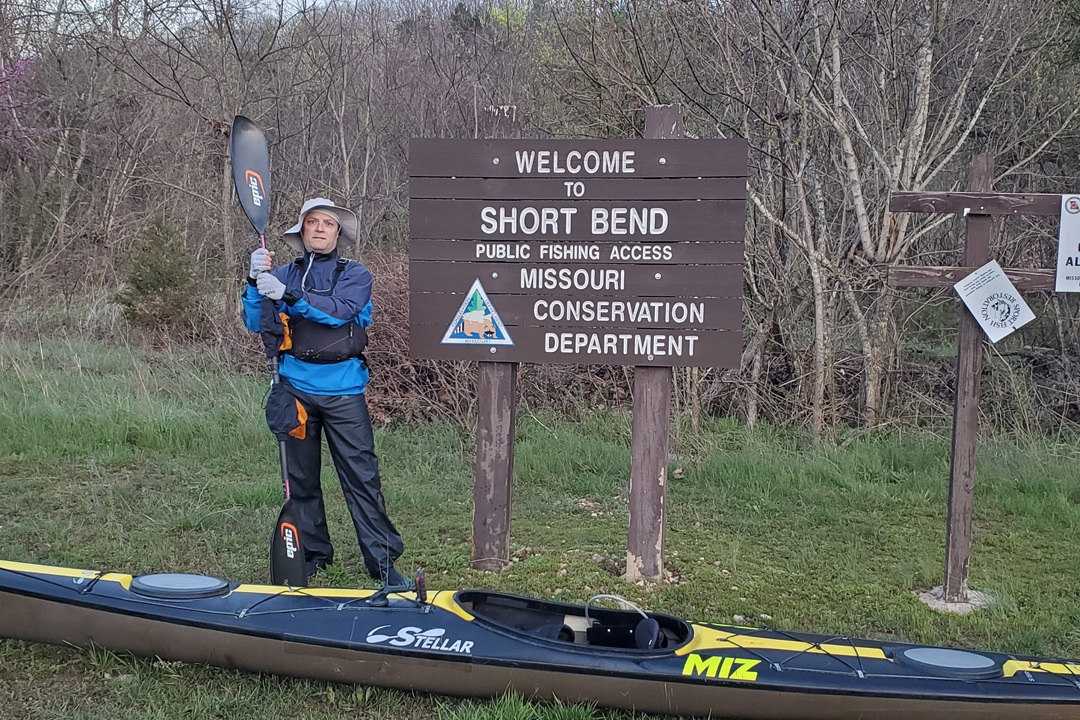
Pete Larson set a record that, until recently, no one had officially attempted.
Earlier this year, the 46-year-old completed the first sanctioned Fastest Known Paddle (FKP) of the Meramec River, more than 200 miles from its headwaters to its merging with the Mississippi, in 39 hours and 21 minutes.
The accomplishment is the latest milestone on his lifelong paddling journey. “You see things paddling that you don’t on a road or trail,” Larson says. “Animals treat you as part of the background, not as an intruder.”
After dabbling in whitewater kayaking in his 20s, he took up distance paddling in 2021, completing the MR340, the world’s longest nonstop paddle race, which takes place in Missouri, in 2022 and 2024.
“I want to be moving, not just floating,” he says. “There’s a natural high when you’re moving smooth and fast and things go well.”
The Meramec attempt, he says, combined his love of speed and distance with “so many memories: the old caves I used to explore, the times I’d taken my family on stretches, catching trout along the upper and lower portions.”
As a shop teacher at Parkway Central Middle School, Larson has tight windows for training and record-setting. He wanted to go during a spring full moon.
March’s full moon fell during spring break, which didn’t work for his schedule, and May’s coincided with the high school graduation of his son, Brendan. So he settled on April 11-12.

To legitimize his quest, Larson submitted a proposal to fastestknownpaddle.org, a website that sanctions and standardizes routes for canoeing and kayaking.
He included starting and ending points, known hazards, and obstacles. His route was verified by Fastest Known Paddle volunteers.
“While others may have paddled the whole river, we couldn’t find a record of someone doing it in one sitting, or any recorded period of time someone took to complete it,” Larson says.
His training included participating in the Creve Coeur Lake Show Me Oars Day 5K series, which takes place on Tuesday evenings during the warm weather months, and additional paddles with group members on weekends.
He left a few details to the last minute, most of which paid off. His only purchase for the trip was a Garmin InReach Mini 2: a GPS tracker and satellite communicator, in case his cell phone didn’t work.
He took two boats to the drop-in, opting for his carbon-Kevlar, 18-foot Stellar racer over a smaller plastic kayak because of its weight, and then packed a lighter, fire starters, a couple of Clif bars, and a Mylar emergency blanket.
Hitching a ride from son Brendan, Larson launched at the Short Bend access near Salem, Missouri, with a goal of seven miles per hour — 26 to 32 hours on the river.
He allotted time to limbo under a few bridges as well as portage. He also planned a handful of meetups with Brendan for cheeseburgers and shakes.
But along came the unexpected.

The first four miles were “incredibly intense.” Here, the river is more of a large creek trapped in between tight walls. It constantly twists and turns, with blind corners and last second corrections made all the more fun in an 18-foot boat.
Then he “dumped,” falling out around mile 36. “I’ve never flipped except in whitewater,” he says. “It caught me by surprise, but I got lackadaisical.”
He quickly retrieved his boat and pulled ashore to assess the damage. He lost a GPS device but still had his phone and two other GPS backups, required for sanctioning a run.
Later that evening, fog set in near Onondaga Cave State Park (mile 60), a stretch he had not paddled before. Hoping to finish before sunset the next day, he soldiered on from 8 p.m. to 1:30 a.m.
“I should have gotten off the river by 11,” he says. “I could put up with the cold and fatigue, but eventually I couldn’t push past what I couldn’t see.”
Larson found a sandbar, gathered firewood, then pulled out the lighter, fire starter, and blanket. For a couple of hours, he chatted on the satellite phone with his wife, Anne.
“I was proud of myself for being responsible,” he says. “It was nice to connect with Anne to take my mind off the cold and losing time.”
The next morning, on a stretch he knows well in Franklin and St. Louis counties, he faced backwater. “Again, that’s never happened there,” he says.

Although he lost the help of the current for the last 18 miles, he had well-wishers encouraging him along the way until he reached the Mississippi confluence at 10:22 p.m. Saturday.
Other than missing his goal of finishing before sunset, his biggest regret was not bringing a spare paddle and pair of pogies: mittens that protect a rower’s hands from cold. Six weeks after setting the record, his fingertips remained tingly.
Establishing one record has left Larson hungry for more. He has proposed routes to FKP on the Bourbeuse and Big rivers, as well as Courtois and Huzzah creeks.
And on the distant horizon is thru-paddling the 2,431-mile Missouri River.
Hoping to launch in June 2026 at the headwaters near Bozeman, Montana, he plans to give himself 60 days, which will make for a tight schedule.
“There’s lots to see, but that will be for a different trip,” says Larson. “I enjoy it most when I’m moving fast.”