
In an era of Zoom calls, texts, and social media feeds, the idea of an old-fashioned reunion can feel outdated. But on April 24, a gathering of former members of the Spirits of St. Louis cycling team proved otherwise.
They arrived at Billy Goat Bicycle Company in Kirkwood slowly throughout the evening — former teammates, spouses, old rivals, and friends — but once they were together, the years seemed to disappear. Stories resurfaced. So did the camaraderie.
For anyone involved in St. Louis cycling during the 1980s and 1990s, the Spirits were impossible to ignore. Guided by longtime coach Jimmy Schneider, the team became a regional powerhouse with a nationally respected junior program. When the Spirits showed up to a race, everyone noticed.
As a young racer, I mostly knew them from behind. Riders like Kevin Livingston, Chris Yenkey, Jason Kippenberger, Ryan Schiff, and others routinely controlled the front of the race while the rest of us tried to hang on. To younger riders, they were mentors, role models, and, occasionally, intimidating figures.
But at the reunion, what stood out most wasn’t the resumes or accomplishments. It was the connection. Watching former teammates embrace, laugh, and retell stories from decades earlier, it became clear this was more than a cycling team. It was a family.
Among the group was six-time Tour de France finisher Kevin Livingston, whose professional career took him from St. Louis training rides to the highest level of international cycling. Between conversations and stories from the road, Livingston reflected on the influence of the Spirits, his years racing in Europe, and the people who shaped his career.

Kevin Livingston at the Spirits of St. Louis reunion in April. (Billy Goat Bicycle Co.)
What do you remember most about those early rides before the racing and the career?
As a kid, I was lucky to be exposed to different sports: soccer, tennis, football, running, and wrestling. Wrestling had definitely become my favorite, but when I found cycling, there was no doubt there was another level of interest and draw to it. My brother had to adopt me as his riding partner after my uncle left for the summer. I still remember when he got his first new road bike. I hid my enthusiasm until he and I dug an old 10-speed out of our garage to start building my first ride. We had a lot of fun exploring roads together and imagining we were racers. At the time, we had no idea there were any other races than the Tour de France on TV. Another draw was just getting out and, in a few hours, covering 40 to 50 miles and being so far from our house and then suddenly back home. Definitely an adventure and a way to get energy out.
How did the Spirits of St. Louis cycling team shape your development as a rider?
The Spirits was the beginning of my racing career. I remember on the first rides seeing the guys’ equipment, stuff I’d only seen on TV or in magazines. Clipless pedals and real cycling kits. At the reunion, I hoped to share with my old teammates that they had an influence on me that maybe they were not aware of. Things I observed and learned from watching them and things they said that had a lasting impact on my mentality that I carried with me through the pro years.
How did you hook up with the Spirits and Jimmy Schneider?
My brother and I naturally recruited my best friend, Andy, who lived up the street. Once my brother went off to college, Andy was my riding partner. One day near our house at the end of a ride, we met Ray Florman Jr. and his wife, and they mentioned racing and calling A-1 Bicycle to get information. This came as a surprise to me that you could join a team. That night, I found Jim Schneider’s number through the shop and talked with him. I wanted on the team and insisted I send my $25 check for joining even though he suggested I meet the team first and see. I ran upstairs, asking my dad if he would send a check, and then announced to my family that I was on a cycling team.
What does the team mean to you, and why is this reunion so important?
I have so many experiences and memories of racing with the Spirits. As you heard on Friday evening at the reunion, there were some great things shared and you could feel everyone was trying to convey their appreciation for the Spirits experience. Jim Schneider had and still has an incredible passion for the sport. He takes it to another level, though, in that he brings riders along, getting the best out of them while embedding lessons and tools that are there even after moving on from competitive cycling. He defines what it is to be a true coach and mentor.
For readers who may not know, what made the Spirits such an important part of the cycling scene?
The Spirits was a Team. We raced under Jimmy’s guidance and learned strategy and tactics. He held us accountable with our training and in supporting each other. Cycling is a team sport, and that is even more evident at the pro level. It was unique in that we had the opportunity to train together and have training camps and go to races together.
You eventually made the leap to racing in Europe. What was that transition like?
Jim used to always challenge me and tell me it was time to take another step. The dream of being a professional is a bit just that — dreamy. In taking steps, it became more a reality each time I was able to get closer to that goal. It was amazing to get a phone call in the fall of 1994 from Jim Ochowicz, the head of Motorola Cycling Team, offering me a contract.
You raced during a pivotal era for American cycling. What stands out to you from that time?
So many years later, my career feels like a blur. During it, though, it felt like you would never do anything else in your life. Initially being on an American team, Motorola, it felt incredible to be at that level. Then, as I moved around teams, you want to assimilate and prove you can make it and can compete with the Europeans. Going to U.S. Postal and being a part of Lance [Armstrong]’s first two wins was obviously another level.
Do you have a favorite memory from your racing years?
My first year as a pro, I was disappointed that Andy Hampsten had left Motorola for Banesto. I followed him as a kid and looked up to him. I was anxiously awaiting a race where he would be riding to see him in person. Finally in one of the early stage races in Spain, I saw him on the start list. On the first stage, it was lightly raining and really windy. He came beside me in the peloton and looked over and introduced himself. Just then, up ahead, you could see the group starting a right turn and everyone getting nervous and the pace increasing. He took one last look at me and said, “Welcome to Hell.” (laughs) I thought that was the coolest thing.

A vintage bike and jersey on display at the Spirits of St. Louis reunion. (Billy Goat Bicycle Co.)
Do you have a favorite team bike?
These are tough questions! The Eddy Merckx Caloi bikes were just cool. Pinarello on Telekom. You know the story. Hard to beat the technology of those first Trek OCLV carbon bikes. If I could get one bike today, I’d like the steel version of my Motorola bike. That was my home training bike away from the races. It probably weighed 23 or 24 pounds and was bulletproof. That’s a bike I could enjoy today!
What’s the hardest race you remember?
Well, all I can tell you is I don’t remember any easy ones.
Who was a better talent, Lance Armstrong or Jan Ullrich ?
They were very similar in terms of their raw physical traits and talents, and had great battles. Lance obviously had the edge.
What does the legacy of the Spirits of St. Louis Cycling Team mean to you today?
For me, the reunion and getting together was such a great time and another memory to add to the Spirits legacy. Jim was such a strong association for me to the Spirits, and the fact that he still coaches is like it’s still being passed along and experienced by other riders.
Cycling has become more accessible in recent years. What excites you about the future of the sport?
I’m a roadie at heart. People ask me if I mountain bike all the time. If you lined up a mountain bike, gravel bike, and road bike, I’m always going to grab the road. Now, I did break down and join the gravel community last year and hope to do some more gravel riding this summer. Gravel riding seems more accessible with less traffic to contend with and events where it’s mass start and more the running marathon model, which I think is attractive to the American take on sports. The Gran Fondos are great too!
What are you doing now, and what do you hope people in St. Louis take away from your story?
Two years ago, my wife and I moved from Austin, Texas, to Petoskey, Michigan. It brought us a little closer to our kids, and we’ve always enjoyed this area and Lake Michigan. I’m still coaching athletes and also work in IT for a company out of Ann Arbor. I like the challenge of learning new things, and that’s definitely what drew me into computers. Hopefully, people from St. Louis head over to Billy Goat Bicycle and get hooked up with a sweet bike and experience the joys of riding!
Author: Dirk Sprogoe is the co-owner of Billy Goat Bicycle Company in Kirkwood, Mo.
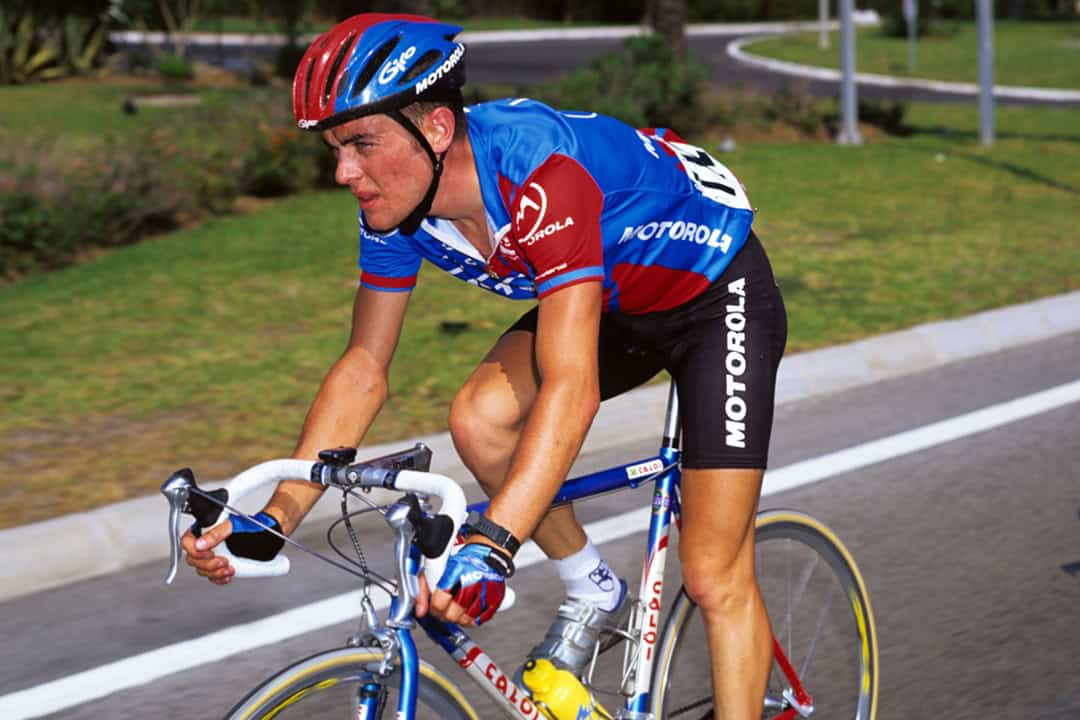
Top Image: Kevin Livingston on stage seven of the 1996 Vuelta a España from Malaga to Marbella. (Courtesy of Kevin Livingston)
Great piece! I was first introduced to cycling seriously by Ray Florman Sr. in the early ’70’s. Early member of the Spirit’s. Raced with Jimmy. Fondly remember the road trip in 1975(?) to Louisiana to compete in the Olympic Trials. Per usual, Jimmy was ‘ burning the candle ‘ early and often! I promoted and assisted in promotion of a few races in early ’80’s.
I applaud Jim Schneider and others who continue to encourage young riders! I will also have to visit Billy Goat on my next visit to the Lou😀.
The Florman’s, Richard Sr., Raymond Jr., & Richard at A-1 Bicycle (now Billy Goat) were very supportive of my foray into bike racing in the 1980’s. I’ve held onto the Pinarello A-1 built for me, The frame commemorates Alexi Grewal’s Olympic gold medal on the road. St. Louis had several strong racing teams in the 80’s including the Spirits, Cyclones and StL Cycling Club. Kudos to Kevin Livingston for his phenomenal success and recognizing his St. Louis cycling roots. 🚴♂️💪