
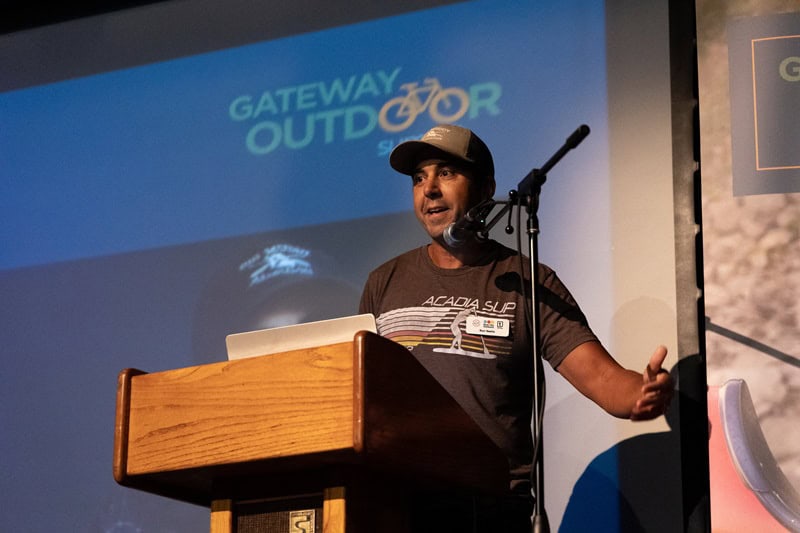
“I’m here to make everyone else not feel underdressed,” quipped Roo Yawitz.
Yawitz, president of the nonprofit River City Outdoors (RCO), was standing onstage at the .ZACK Theatre in Midtown St. Louis, dressed casually in a T-shirt, shorts, and baseball cap.
It was 10 a.m. on August 20, and Yawitz was kicking things off at RCO’s 2026 Gateway Outdoor Summit — a free, daylong gathering built around one big question: How does the St. Louis region get more serious about the outdoors?
Jokes aside, Yawitz made clear why more than 200 guests had shown up: to brainstorm how to make the outdoors a bigger part of St. Louis’ identity — and maybe even turn the city into an “outdoors town.”
“We love the outdoors,” Yawitz said. “As we look to the future of St. Louis, the more we lean into the outdoor side of our community, the better we’re going to be.”
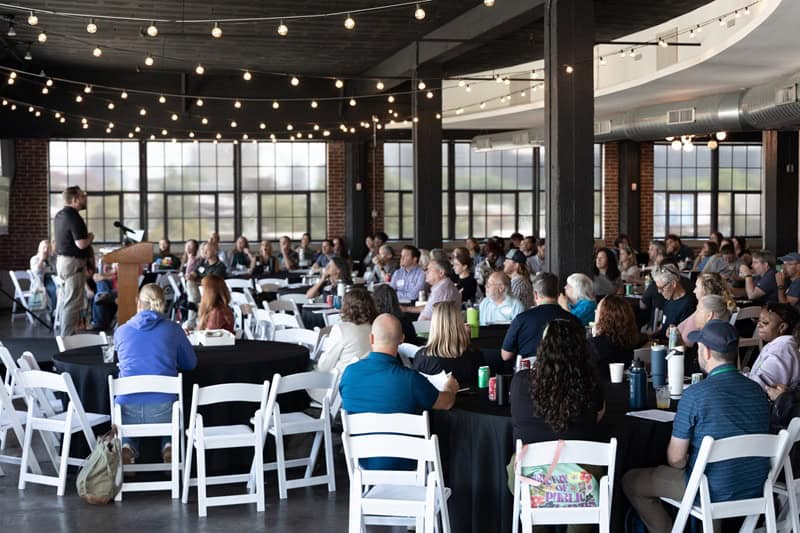
Speeches, discussions, and Q&A sessions rolled on from there, running well past 5 p.m. at the adjacent Key STL.
As the managing editor of Terrain, I spent the day feverishly taking notes on everything I heard and saw. (Which was a lot — I filled an entire notebook in seven hours.) So as we look back on the event, I figured I’d empty that notebook and give you my main takeaways from the day.
Full disclosure: RCO is Terrain’s parent organization, so if you came here looking for a scathing takedown of the event, you’re going to be disappointed.
OK, here we go…
The Rock Island Trail is gaining momentum. Dan Burkhardt, president of the nonprofit Magnificent Missouri, spoke about the struggles to make the 240-mile Katy Trail a reality in the 1980s, when the rail-trail movement was brand-new (and the longest rail-trail in the country was an astonishingly short 10 miles). Farmers opposed construction of the Katy, and it was only completed with the help of Ted Jones (the former CEO of Edward Jones), who donated $2 million of his own money to the cause.
Fast-forward to 2026, and the 200-mile Rock Island Trail, if completed, would connect with the Katy at two points, forming a full loop that cyclists (and runners and walkers) could use to cross the entire state of Missouri and return. “It’s a case of ‘If you build it, they will come,’” said Burkhardt.
Sprawling bike trails like the Katy and Rock Island not only bring in tourists and tourism dollars from around the country and the world, Burkhardt said. They also offer health benefits for Missouri residents and provide a space to highlight native plants and artwork.
But Burkhardt wasn’t the only one beating a drum for the Rock Island Trail. The project was mentioned repeatedly throughout the day, and it’s a focus of the upcoming documentary The Trail State from St. Louis-based Once Films. Burkhardt screened a trailer for the documentary, which will air on Nine PBS on October 12.
The Gateway Arch Park Foundation has several intriguing irons in the fire. Arielle Claypool, a communications and marketing executive for the Gateway Arch Park Foundation, provided an update on her organization’s top action items. (As a reminder of the importance of this group, the Arch has an annual economic impact on the St. Louis area of around $570 million.) Specifically, she cited four main projects.
First, they’ve acquired the former Millennium Hotel. Claypool said the tower is coming down and will be cleared by the end of 2027, making way for a $670 million mixed-use redevelopment project. “If the areas around the park cannot thrive,” she said, “the park cannot reach its full potential.”
Second, they’re expanding into East St. Louis, working on developing the park directly across from the Arch.
Third, they’re revitalizing the riverfront, exploring ways to add “visitor amenities” to the area south of the Arch. When asked, she didn’t want to elaborate on what those amenities would be, so your guess is as good as mine. Could it be hotels? Luxury apartments and shops? A Jamba Juice like on DTF St. Louis? They’re still exploring options with stakeholders.
Finally, the group is studying the I-44 corridor. Claypool mentioned that a trend in other cities is to remove the highway entirely — so that seems to be a move they’re considering, which feels like a bold and exciting step. “There is an opportunity for seamless connection to our park and our riverfront,” she said.
The Brickline Greenway is getting there. Mark Perkins, CEO of Great Rivers Greenway (GRG), discussed the latest progress of the Brickline Greenway, what he called GRG’s “most ambitious project ever.”
When completed, the 10-mile network will connect four major parks of St. Louis: Fairground Park, Gateway Arch National Park, Forest Park, and Tower Grove Park.
In doing so, it will stitch the surrounding neighborhoods together, Perkins said, comparing it to Atlanta’s Beltline and Indianapolis’ Cultural Trail.
“It’s about connecting St. Louis in a unique way,” he said, “and bringing nature back into the city.”
Another hope is that once the $245 million public-private project is completed, it will attract more people to live in the city.
“One of our goals is to bring population back to the city of St. Louis,” he said.
The North Grand stretch of the Brickline Greenway, once one of the most dangerous places for pedestrians in the entire country, is slated to be completed in 2027. This should make things safer by narrowing the street, among other strategies.
GRG is also creating a crossing over I-64 at Spring Avenue (near the Armory), which is scheduled to be done by 2028.
Overall, the plan is to have the entire Brickline Greenway in construction by 2030. Of course, many stretches are already completed and bikeable, runnable, and walkable.
Plans are firming up for the US Olympic Marathon Team Trials. As you might have heard, St. Louis was recently named host city for the US Olympic marathon team trials as a lead-up to the 2028 Summer Olympics in Los Angeles. Mona Vespa, president of GO! St. Louis, spoke enthusiastically at the Summit about the event’s impact.
Vespa said the Olympic marathon trials will take place the same weekend as the 2028 Greater St. Louis Marathon, which GO! St. Louis organizes. (The Greater St. Louis Marathon will happen the day after the team trials, and the marathon routes will not be identical, but there will be some overlap.)
Vespa also said she expects 100,000 people to visit St. Louis for the marathon team trials, which will be broadcast nationally on NBC.
“We’ll have time to show off all those beautiful St. Louis neighborhoods,” she said. “It’s going to make our city look good.”

It will also bring in major dollars. When Orlando hosted the marathon team trials in 2024, it generated about $15 million for the city. Vespa expects the 2028 marathon team trials to have a similar impact on St. Louis.
Branding is powerful, as Oklahoma City has proven. In the presentation “What’s Possible Here: Lessons From Cities That Bet on the Outdoors,” Melanie Borger from Oklahoma City’s Riversport Foundation talked about how her city has transformed itself into a world-class paddling hub.
In the 1990s, Oklahoma City was a divided city with a barren river, and it was arguably most known for the horrific act of domestic terrorism that killed 168 people at a federal building.
Now, thanks to due diligence, vision, planning, and an ingenious penny sales tax program called MAPS (Metropolitan Area Projects Plan), OKC has rebranded itself as the “Paddle Sports Capital of the World.”
The centerpiece of this transformation is Riversport OKC, a massive, world-class outdoor adventure park. Located along the Oklahoma River in downtown Oklahoma City’s Boathouse District, the park uses six high-powered water pumps to generate class II-IV whitewater rapids, serving as a recreational hotspot for families and a premier training ground for elite athletes.
Because of this facility, Oklahoma City will host the canoe slalom and kayak cross events at the 2028 Summer Olympics (as well as softball), making it the only city outside of Southern California to host an entire Olympic event.
“What worked for us was collaboration and humility,” said Borger. “But you’ve got to be willing to take risks.”
This got me thinking: What outdoor thing could St. Louis become the international capital of? (It’s already a capital for chess, bowling, and toasted ravioli, but maybe it could strive for more.) Could it build its own Riversport-like facility (e.g., Riversport STL) next to the Mississippi River? Could it build a world-class bike park within the city? Could it do both?
When in doubt, add parks. In the same session, Kristina Anderson, recreation supervisor at the Minneapolis Park & Recreation Board, discussed how Minneapolis has transformed its downtown Mississippi Riverfront over the past several years.
“We keep adding parks,” said Anderson. “Our parks are our canvas.”
When it comes to park events, Minneapolis has shown it can think outside the box. In July, for example, they hosted an outdoor snowball fight that generated a ton of buzz on social media. The city doesn’t have any pickleball courts downtown, but that didn’t stop them from holding a huge Pickleball in the Park event by creating temporary pickleball courts on nearby pavement.
And don’t think that Minneapolis shuts down in the winter. “Winter is our secret weapon,” said Anderson. “It’s not our offseason.”
In recent winters, Minneapolis has created snow sculptures, hosted a disc golf tournament, and put on an event called winter ice lantern making. The lesson they learned is that these types of events make the parks come to life.
“We want parks that feel alive,” said Anderson. “Activation gives people a chance to linger, to get to know each other, and to fight urban loneliness.”
Partly due to these vibrant parks and fun events, Minneapolis’ downtown Mill District, a redeveloped riverfront area, is one of the fastest-growing neighborhoods in the US. Anderson said a lot of young people are moving to the city without cars. The key to fighting the “car-centric mentality”? Good public transportation and lots of bike trails.
Anderson also recommended changing the public perception of your city through social media — for example, creating “How to Get to Downtown” videos to show how easy and safe it can be.
Finally, she suggested keeping an open mind when creating events or problem-solving: “We’re constantly asking, ‘What’s possible here?’”
Missouri’s state parks are a powerhouse (and also pretty pale). After lunch, on .ZACK’s fourth floor, Daniel Engler, the planning section chief for Missouri State Parks, shared results from a recent economic impact analysis conducted by the University of Missouri. Among the findings:
The Missouri state parks system generates about $1.5 billion in total business sales annually and supports about 12,000 jobs — all on an annual budget of “only” $68 million.
Missouri’s state parks welcome about 20 million visitors a year.
While 91% of visitors are Missouri residents, nearly half of visitors (48%) travel more than 60 miles to reach a park.
Katy Trail State Park in particular continues to be a major driver of regional tourism, with most users over 60 and college-educated.
In 2025, direct visitor impact on the Katy Trail reached $24.6 million, supporting 261 jobs and contributing $20.2 million to the state’s GDP. But when you factor in total household investments related to the trail (such as buying a bicycle for trail use), the Katy Trail’s full economic footprint grows substantially.
Katy Trail day users spend an average of $45 per day, mostly at local restaurants. Overnight visitors spend triple that amount, averaging $148 per day, with lodging the largest single expense at $67 per night.
To the extent Missouri State Parks can persuade people to become overnight visitors, said Engler, it’s a win for the state’s economy.
“When thinking about how to keep people on the trail longer,” Engler said, “I don’t think it takes a genius to understand the economic opportunities this presents for us.”
On a less-awesome note, use of Missouri’s state parks remains disproportionately white. Engler estimated that white people might make up as much as 97 percent of park visitors. That said, Missouri State Parks coordinator Kintauna Myles emphasized that the organization is working to address this imbalance.
To see more data, you can check out the full report here.
Midtown St. Louis has more murals than you might think. In one of the most fun portions of the day, attendees had the option to get outside for an hour and check out one of three locations: the Big Muddy Adventures canoe warehouse, a section of the Brickline Greenway, or the Walls Off Washington mural gallery.
I chose the last option, along with about 30 other folks, and man, am I glad I did. Even though I work in the Midtown area every day, I had no idea there were this many colorful murals painted on buildings and in alleyways — and that many were created by internationally recognized artists.
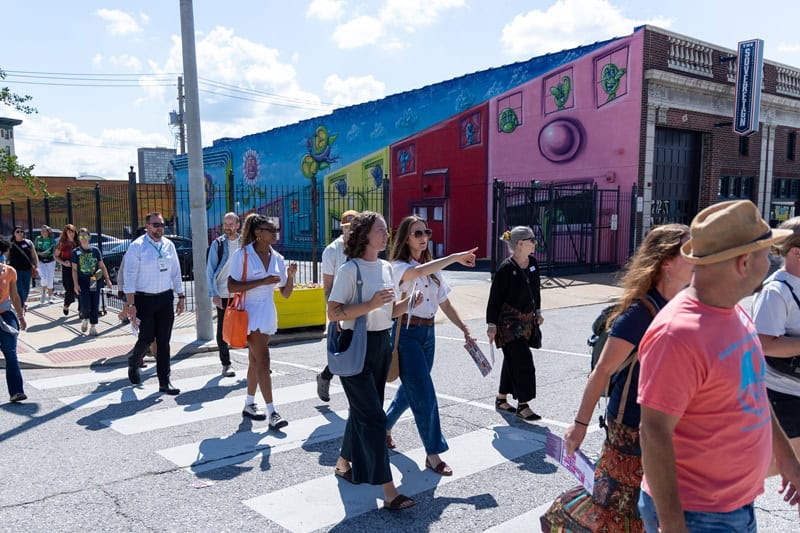
Gina Grafos and Brandon Anschultz from the Kranzberg Arts Foundation, the group behind the mural project, gave us a tour of the Walls. In total, there are 32 murals and counting in the Midtown area, spanning Locust Street, Leonard Avenue, Washington Avenue, and the alleyway behind High Low coffee shop and Sophie’s Artist Lounge.
Though I had seen some of these paintings before (in fact, our May-June “Bike Issue” cover features one of them), I never noticed that each mural includes an artist nameplate in the lower-right corner, so you can see who did it and what it’s called.
During the tour, I learned that High Low hosts a speaker series every Thursday at noon (aptly titled “High Noon”) and that you can take a self-guided tour of the Walls Off Washington, starting at a small merchandise shop next to Sophie’s on Washington Avenue (3333 Washington Ave). They’re open Wednesday through Saturday from noon to about 8 p.m., and it’s free.
Among the murals is one, “Kranzbergville,” by artist Kenny Scharf, who came up with Jean-Michel Basquiat in the New York art scene in the 1980s and even gets a shout-out on Madonna’s new album Confessions II on the track “Danceteria.”
But my personal favorite mural of the tour was “Lift as You Climb” by Derrick Adams, which shows a bunch of people climbing ladders and lifting up folks beneath them. Lively image and a good message.
Anthony Reed has run quite a few marathons. At 4 p.m. in the Key STL event space (housed in a cathedral-esque converted building), Anthony Reed stepped onstage and delivered the event’s keynote address.
Reed, a St. Louis native and graduate of John Burroughs School, talked about how he became the first African American to complete the “marathon hat trick”: running 100 marathons, running a marathon in all 50 states, and running a marathon on all seven continents.

In fact, the running gear he wore for his Antarctica marathon is now displayed at the Smithsonian’s National Museum of African American History & Culture in Washington, DC.
Reed co-founded the National Black Marathoners Association and discussed the challenges of persuading Black Americans to run marathons. They lacked role models and were fighting the myth that African Americans were sprinters, not long-distance runners.
But Reed had someone to look up to — St. Louis’ own Dick Gregory, the comedian and activist who ran across the U.S. in 1976 to raise awareness of world hunger.
When Reed ran his first marathon in 1982, he faced pushback. “The white people around me were telling me that I was in the wrong race, that I needed to pick a shorter one,” Reed told the crowd. “What they didn’t understand is that I had a role model: Dick Gregory from St. Louis.”
Reed, now 71, says he hasn’t run a marathon in a few years. But he still jogs about three miles a day on average and is training for another marathon.
During the Q&A portion of the keynote, someone asked Reed where to find the motivation to run a marathon. Reed advised looking inward.
“You have to have a good reason to run it,” Reed said. “I’ve run 99 percent of my marathons by myself. It represents freedom to me.”
Author: Shawn Donnelly is the managing editor of Terrain.
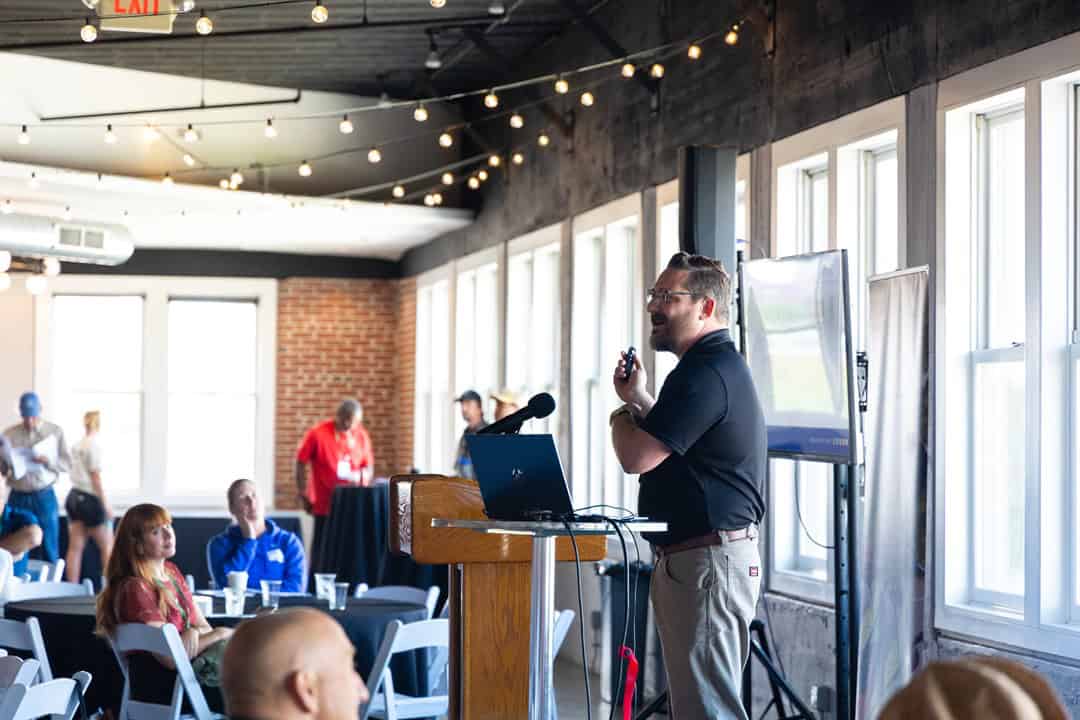
Top image: Daniel Engler of Missouri State Parks speaks at the Summit. (Reiss Wegman)