

“Missouri is filthy with trash out in the woods,” says Missourah Endurah co-founder Drew Teghtmeyer. “You have this beautiful scenery down here in the Ozarks, and it seems like the people that drive through are more than happy to just toss their trash out into the ditch.”
Teghtmeyer, an Iowa farmer, wanted to do something about this trash situation, and he came up with an idea: throw a Gambler 500 Rally in Missouri.
What’s a Gambler 500 Rally? According to legend, it originated at a bachelor party in Oregon, where friends decided to explore the countryside in whatever automobile $500 could get them and pick up whatever trash they found along the way. (The name “Gambler” comes from the gamble that participants make on their less-than-stellar vehicles surviving the adventure.)
The original Gambler 500 in Oregon has since grown into an annual rite of passage for gamblers worldwide. After connecting with the Oregon founders, Teghtmeyer received permission to use the Gambler 500 name, and in 2018, the Missouri Gambler 500 — aka the Missourah Endurah — was born.
“It’s this big ol’ scavenger hunt in the woods,” says Teghtmeyer, who now has a team of people helping him organize the event.
Currently, the Missourah Endurah takes place annually at Hooter Holler Offroad Park in the Ozark town of Mountain Grove. This past September, I made the three-hour drive from my home in St. Louis to experience the event firsthand.

Drew Teghtmeyer started the Missourah Endurah in 2018. (Jason Gray)
After setting up my tent, I walked around camp, meeting gamblers and gawking at their outlandish rigs. The air rang out with engines revving and the sound of tires turning up the earth, seemingly taking turns from opposing directions. Mixed in with this were two other sounds: the odd, piercing “ahooga” of a vintage horn (from a vehicle that I would become familiar with the next day) and country music spilling from speakers at several campsites.
My conversations turned toward my need to secure a spot as a ride-along in someone’s vehicle for the next day’s big event. Several folks facetiously encouraged me to just drive my Toyota hatchback. Eventually, I ran across Zane Jackson and his group.
Jackson lives in Chicago, but he has been participating in the Missourah Endurah since 2019. “I always just liked shitty cars,” Jackson says. “A buddy of mine wasn’t going to be able to make it, so he just gave me the keys to his rig, and it all went downhill from there.”
For this Endurah, Jackson was driving a gold 2003 Dodge Caravan that he added side exhaust and rally tires to. He says he keeps coming back year after year because of the people. “Everybody is super cool,” says Jackson. “There’s no assholes here. Everybody just helps out with everybody else and has a good time.”
Jackson gives an example to support his comment. Last year, his vehicle was rapidly leaking coolant, and his group had run out of water. So he passed around a jug and had everyone pee in it, and they used this particular cocktail for coolant. “That was awful,” he says with a laugh. (The story is a bit ironic considering that, at an Endurah several years ago, Jackson pulled a porcelain toilet out of the woods.)

Kyle Wehner, one of the cheese guys of the Missourah Endurah. (Jason Gray)
While walking between sites, two men wearing Packers-style cheese-wedge hats and flowing, cheese-block-printed capes approached me, and one of them handed me a small slice of plastic cheese. This man, Kyle Wehner from Independence, Missouri, said he looks forward to seeing old friends and making new ones at the Endurah.
“We’ve kind of become known as the ‘cheese guys,’” says Wehner, “so we hand out cheese and talk to everybody.”
The cheese thing comes from Wehner’s first year participating, when he zip-tied a cheese grater to the roll bar of his Jeep. When he showed up the next year without it, people had questions.
“Everybody was like, ‘Oh man, where’s your cheese grater?’” Wehner remembers. “So then it was like, ‘OK, we’ll just run with that idea.’”
After leaving the cheese guys, I met a brother-and-sister team from Iowa, John and Jane Haltmeyer. They offered me a spot in their rig, a doorless Jeep Grand Cherokee, which I gladly accepted.
Recognizing me as a newbie, the Haltmeyers initiated me to Missourah Endurah camp life with a swig from their bottle of Jeppson’s Malört, a prize for third-place finishers in the annual minibike race, and a relic of gambler investiture. It tasted like what I would imagine dirty, wet socks taste like.
Still, it’s the thought that counts.
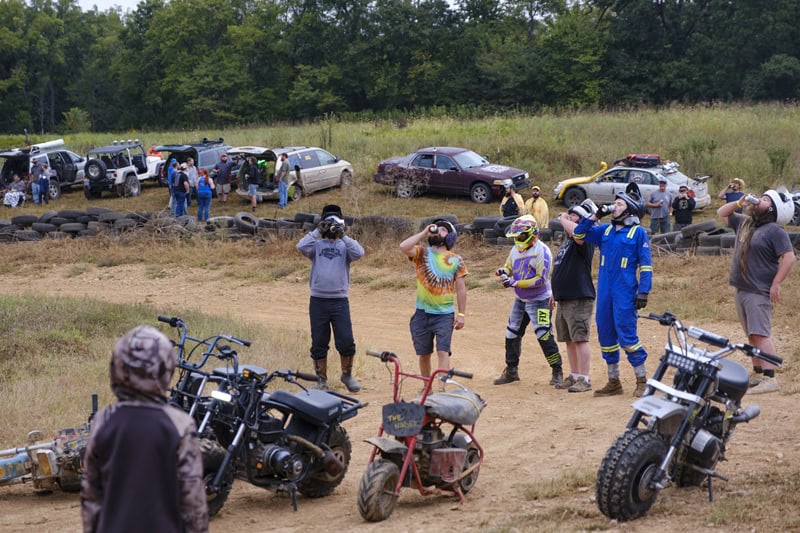
The Minibike Enduro began with an old-fashioned beer chug. (Jason Gray)
AROUND THIS TIME, I heard the distant whine of several minibike engines singing in unison. This meant that Rusty’s Minibike Enduro Race was about to begin. Gamblers rallied their vehicles around a small, circular dirt track. The rules of the race were simple: chug a full can of beer, hop on a bike, ride as many laps as you can in 25 minutes, try not to crash, and don’t die. (This last one is a universal rule for the event, alongside a few others, like don’t be a dick, pick up as much trash as possible, don’t think of this as a race, and make sure your vehicle is street legal.)
Most of the bike riders followed at least four of the five rules, with “try not to crash” being the outlier. By the end, everyone was painted in a thin cake of dust and sweat — and for some, blood as well. Jackson welded the winner’s trophy into the back of his van, and it was announced that next year’s winner would take home the van as well as the trophy. Malört was consumed in deep swills. At this point, it had become clear to me that the entire event would proceed this way, as unscripted waypoints in some surreal fantasy journey.
Back at camp, it started to rain, and night fell. As I finished my dinner in the front seat of my car, the sound of live music from an adjacent pasture pierced the darkness through the open window. I drove up to investigate and found a five-piece band covering rock and country classics under an awning in the wispy precip. A long row of gambler vehicles rested in front, their inhabitants listening to the music.
Here is where I met Phillip and Henry Moore, a father-and-son team from Arkansas, and their vehicle, the Assault Moth. Henry worked under the hood while his dad and I chatted. This interaction taught me two things. The first is that more families do the Endurah together than I had previously realized, and the second is that, down to the youngest participants, these gamblers know their stuff when it comes to fixing and maintaining cars (and often with substantial inventiveness).

Smoky exhaust belched from a participant’s bike during the Minibike Enduro. (Jason Gray)
The next morning, while up early to take some photographs, I ran into one of the site’s proprietors, a very sweet grandmother. “I’m getting ready to serve up some fresh biscuits and gravy and coffee at the food shack!” she exclaimed. Then she talked about how good this group is and how well they clean up after themselves, usually leaving nothing behind except a stray beer can here or there — an impressive feat for an event that generally draws between 200 and 300 participants.
At 8 a.m., all the gamblers gathered near the front of the park to receive their coordinates for the Endurah. This included two routes defined by GPS decimal degrees, the intermediate Trash Strike Route and the more difficult Power Strike Route. While participants received instructions, bought merch, and won raffle prizes, I spoke with Andrew Boston from St. Louis about his breathtaking restoration, a 1989 Jeep Grand Wagoneer.
Among other things, his Wagoneer features a grill from the late 1970s, round headlights, full heist gear, dual fuel tanks, and something called a Detroit locker. Boston told me he did all the renovations by himself in his garage. “I’ve touched everything on this car,” he says. “The research process has been key to helping the rebuild go quote-unquote smoothly.”
Boston says that he is driven to participate in the Endurah every year because of the cause. “Everybody here likes to get rowdy and have fun, but at the end of the day, we’re leaving the public land ten times cleaner than when we found it,” he says. “It’s just so critical that we respect the land that we’re on and clean up after ourselves and others as needed. At the end of this weekend, you’ll see the dumpster, and it’s completely full of stuff. It’s crazy the things we’ll find out there — from airplane tires to refrigerators to diapers — but we’re going to do everything we can to pick up all of it.”

A seemingly endless line of gamblers, poised at the starting line. (Jason Gray)
THE EVENT BEGAN with a roar of engines. Some gamblers peeled away eagerly, leaving a cloud of dust and a few flung pebbles in their wake, while others rolled off slowly and deliberately, laser-focused on the mission ahead.
Our caravan consisted of the Haltmeyers’ muscular Grand Cherokee (where I bumped along in the backseat, occasionally causing the oversized tires to rub against the frame), as well as a restored vintage Ford Bronco, a Ford minivan (source of the ahooga horn from camp, but otherwise ready to pick up kids from soccer practice), a lifted Dodge Stratus, and an old Ford F-150.
Together, we were navigating the rugged Power Strike Route.
Turning off a rural highway, we immediately plunged into the overgrowth that hid a rugged dirt path running beside a row of tall, high-voltage power lines stretching into the distance.
When the cars paused to consider the route, the buzzes and hums from the ionized air around the lines could be heard overhead, mixing with a crescendo of late-summer insects.
The caravan trudged forward, navigating over and around obstacles like boulders and outcrops, sometimes as big as a person, and across pockets of water erosion that threatened to overturn vehicles.
Several times, I was whipped in the face with branches while photographing through the open doorframe. Many vehicles needed to be either towed or pushed away from calamity.

John and Jane Haltmeyer offered the author a spot in their doorless Jeep. (Jason Gray)
Along the way, our vehicles churned up fine particles of the dry reddish earth below, which hung suspended in the air like hazy little clouds. This particulate tended to form little deposits of gunk in the corners of the eyes for those not wearing protection, like me, and this condition persisted for days following the event.
While waiting for team members to catch up, Jane Haltmeyer packed foil-wrapped burritos around the engine of the Jeep to cook under the hood as the adventure continued.
After several hours, the group finally hit an impasse. The ahooga van had lost its exhaust and most of its transmission fluid, and the route ahead was too tricky to try towing it across. The group doubled back to a splinter road acting as a rip cord for the course, where the van could be towed to a gas station and patched up by the owner. (The van would join us again before the day ended.)
This sort of thing wasn’t unusual at the Endurah. Every year, several cars wind up being towed back home with busted motors, transmissions, or differentials. This wasn’t a failure for our team, either. We had completed most of the route and were able to circumnavigate to the other sections, where there was more trash to pick up anyway.
Our caravan rolled into camp just before dark and unloaded the trash and debris it had collected into a 20-yard dumpster positioned by the organizers. We weren’t the first team to return, but we were far from the last, which came screeching in after midnight.
This included Ryan Wright and Austin Davis of Cole Camp, Missouri — first-timers and this year’s “winners,” a designation earned from having a kick-ass car design and for rescuing some stranded gamblers from atop a remote glade.
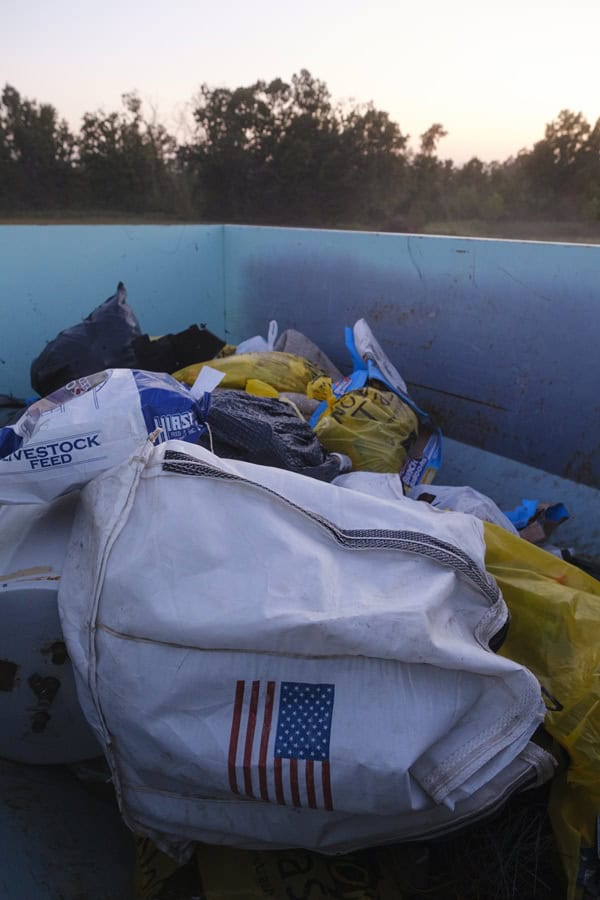
Since 2018, gamblers at the Missourah Endurah have removed thousands of pounds of trash. (Jason Gray)
By morning, the dumpster was overflowing with more than 4,000 pounds of trash, according to organizers. (This didn’t include the dozen or so tires piled up around the base that get processed separately.)
According to Teghtmeyer, gamblers at the Missourah Endurah have removed over 200,000 pounds of trash since 2018. And he’s starting to see a difference in the Mountain Grove area.
“The trash piles aren’t as obvious as they were when we got here,” says Teghtmeyer. That’s one big reason why Teghtmeyer isn’t sure whether the Endurah will continue to call Mountain Grove home for much longer. “There are other areas of the state that need us,” he says, “and other off-road parks that want us.”
So, Missouri, the next time you see an incongruous assortment of off-road vehicles pull up alongside you at a gas station near a forested area, maybe offer to buy them a bottle of water or a tank of gas. Or don’t.
After all, they’re going to clean up our collective trash either way. And they’re going to do it by having more fun in a weekend than most of us have in a whole year.
Author: Jason Gray is a contributor to Terrain.
Top image: Zane Jackson and his gold gambler van. (Jason Gray)
Leave A Comment