
Hanging on the side of a cliff with nothing but a rope to prevent you from plummeting 30 feet to solid ground doesn’t seem like the ideal place to find your zen.
And honestly, it’s not . . . until it is.
This is something I was reminded of recently when I accompanied a veterans group, Veterans Affairs St. Louis, as they worked to combine climbing with mindfulness and meditation.
“Climbing is inherently a mindful activity,” explains Devorah Ginn, a psychologist with VA St. Louis and leader of Grounded in the Heights, a mindfulness-based therapeutic rock climbing program.
I completely agree. Climbing is the one sport I’ve found that consistently pushes me to face my fear and forces me to be present in the moment.
Even when I know I’m safe, a single move can lock me up simply because I perceive it to be beyond my ability.
In those moments, I’m forced to: 1. Breathe. 2. Assess my surroundings. 3. Make one small move.
String a series of those simple tasks together, and the next thing you know, you’re on top of the world. (Or at least on top of a rock.)
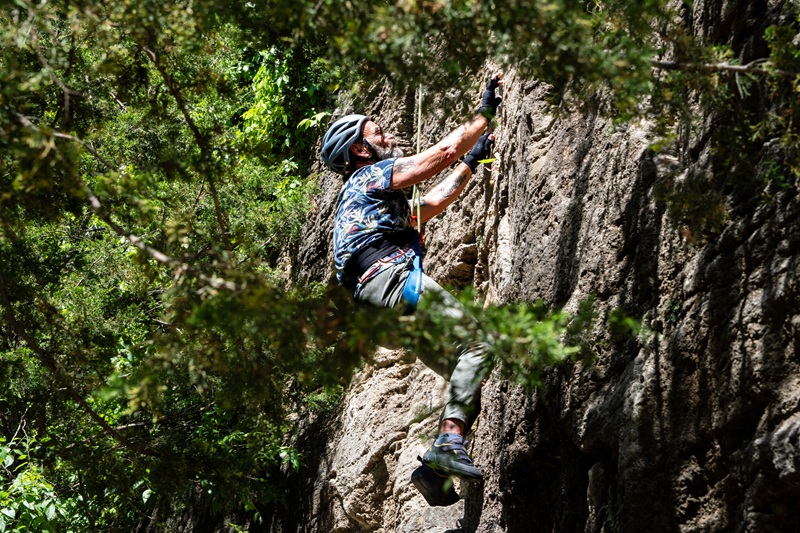
A St. Louis veteran evaluates the moves on Troglobite (5.7) at Rockwoods Reservation. (Michael Shepherd Jordan)
Adaptive Behavior
Grounded in the Heights got its start in the more controlled setting of an indoor climbing gym.
When Dr. Ginn invited me to photograph the group’s first outdoor climbing trip with Adaptive Adventures, I was honored, especially since for many of the veterans, this would be their first time climbing outdoors.
Adaptive Adventures is a nonprofit based in Denver with the mission to help anyone with a physical disability, or any other disability, become active again through outdoor adventures.
And so, on a sunny day this spring, Adaptive Adventures and VA St. Louis members headed to the Rockwoods Reservation climbing bluff in Wildwood, Missouri, to get on some real rock.
The group consisted of about 20 veterans, some with significant climbing experience, some with little to no experience. Rockwoods Reservation’s Colony Wall — the primary climbing area — features 15 routes ranging from 5.7 (beginner) to 5.12a (advanced).
Craig DeMartino, the climbing manager for Adaptive Adventures, and his wife and climbing partner, Cyndy, the group’s sports coordinator, scouted the location before everyone’s arrival and set top ropes for the group.
The couple also provided gear (harnesses, climbing shoes, helmets) to those who didn’t have their own. After a quick safety meeting with the DeMartinos, the veterans were off, up the wall.
“Teaching mindfulness skills is important for our veterans,” says Ginn, “and doing it with the activity of climbing brings it all together.”
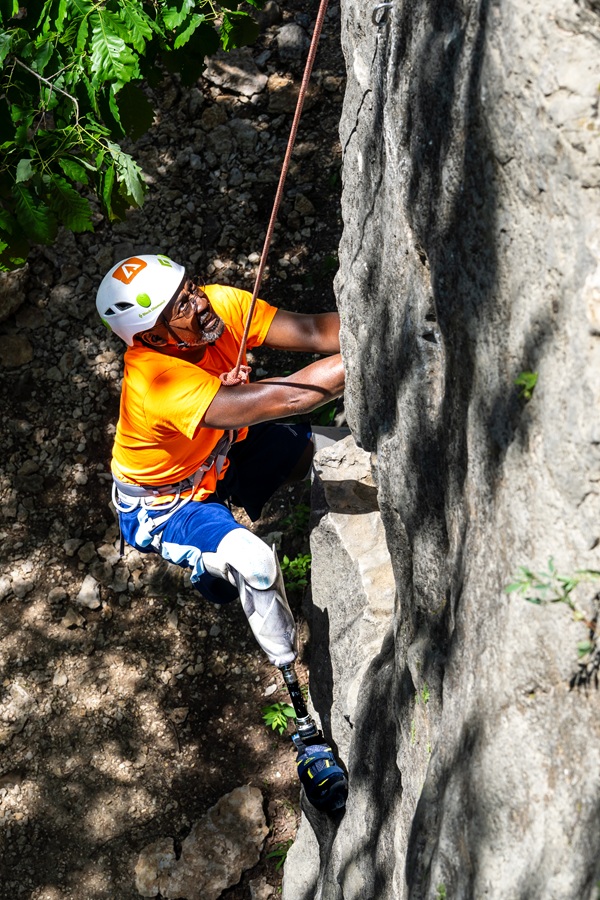
A St. Louis veteran works through the first ledge of Moonseed (5.8) at Rockwoods Reservation. (Michael Shepherd Jordan)
Veteran Climbers
Nick Berkens is a veteran who has been a part of VA St. Louis’ recreational therapy program for the past two years. He’s a fan of the mindfulness elements Ginn has incorporated into the group because, he says, “it adds a whole new element to mental health.”
The idea, says Ginn, is simple: “Let’s actually do the interventions while we’re doing an activity and being social.”
The group climbed for several hours, some people making it to the top easily, others struggling to get off the ground, but what stood out the most was the camaraderie and support that members gave each other.
From belayers patiently waiting and encouraging climbers as they slowly made their way up the wall, to the lunch provided by and delivered to the crag by Wounded Warrior Project, everyone was connected, and the vibes were positive.
“It’s been amazing,” says Ginn. “Everyone wants people to succeed.”
The session concluded with a crag-side mindfulness meditation and group discussion led by Ginn, which correlated the skills and techniques used in climbing with daily life. This caused me to reflect on my own experiences with climbing and mental health.
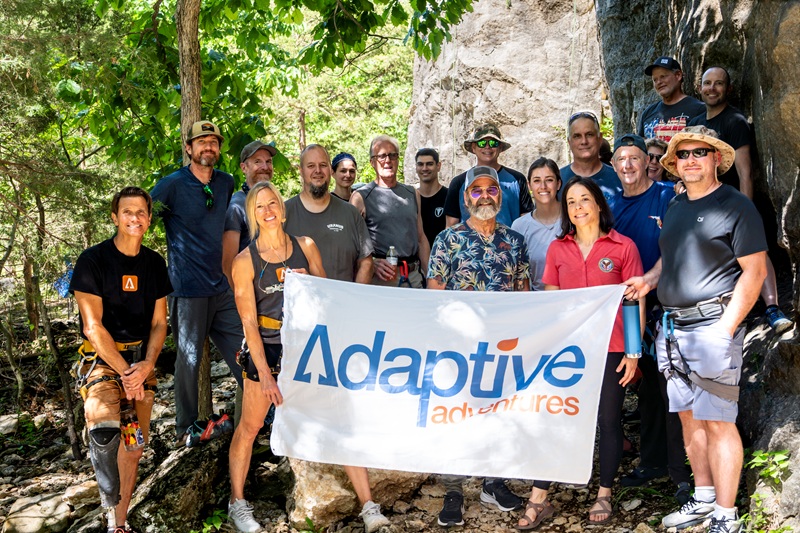
Craig DeMartino (far left) and Cyndy DeMartino (second from left) of Adaptive Adventures with the VA St. Louis Grounded in the Heights crew. (Michael Shepherd Jordan)
When I’m scared, overwhelmed, and don’t know what to do regarding work, relationships, and so forth, I’ll do my best to approach my struggle like I would a problem on the wall: breathe, assess, move.
If I end up taking a fall (or a “whipper,” to use the climbing slang), the rope and my belayer are there to catch me.
I’m not saying falls while climbing won’t ever be serious, but in my experience, my imagined perception of the fall is always worse than reality.
The same goes for whatever perceived anxiety I’m facing in my life at the moment. I can handle it as long as I breathe and work through it one move at a time.
If you’re a veteran enrolled in care with VA St. Louis, you can access the Grounded in the Heights group through mental health services or recreational care services.
Adaptive Adventures hosts outings across the country. For event registration and volunteer opportunities, visit here.
Author: Michael Shepherd Jordan is a contributor to Terrain.
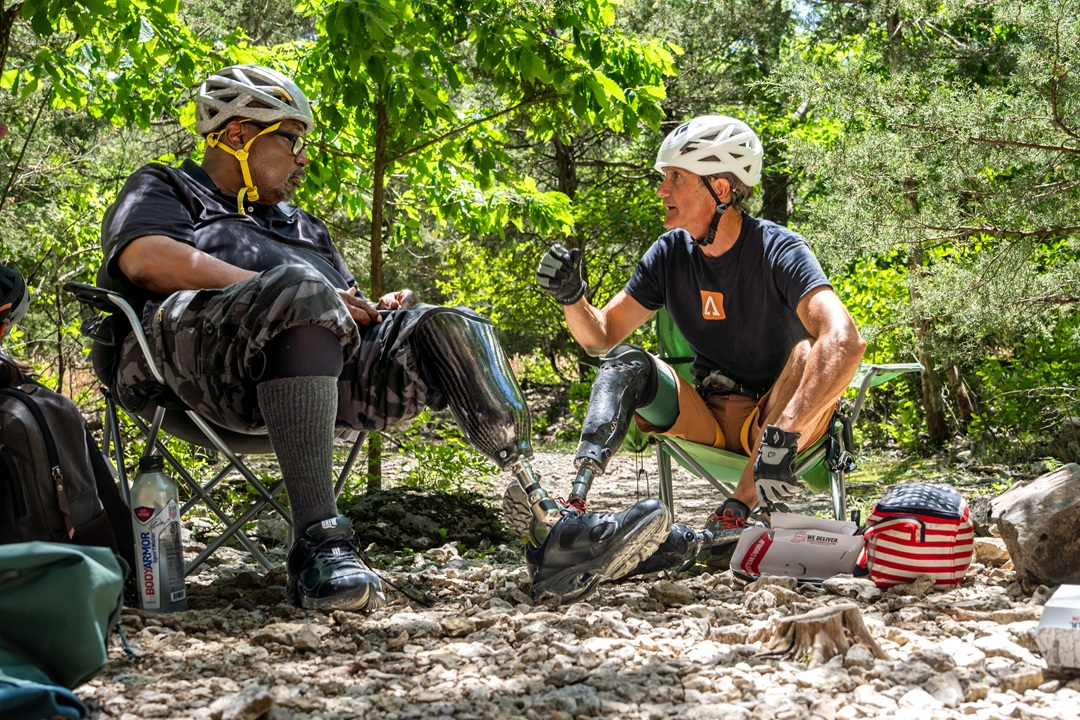
Top image: Craig DeMartino (right) of Adaptive Adventures discusses climbing with prosthetics with a St. Louis veteran.
Leave A Comment