
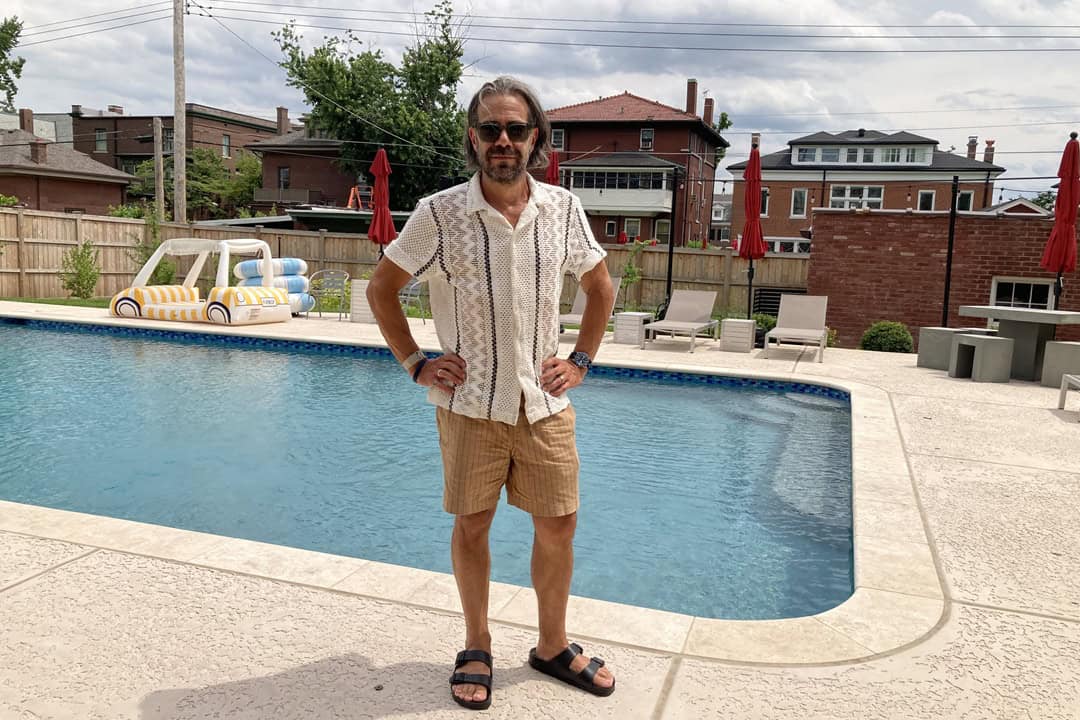
Ian Bogost is wearing a lot more rings than I anticipated. He’s wearing three, to be exact, which is about two more than I expected from a WashU professor. They’re also funkier than I foresaw.
He’s a cool-looking middle-aged dude. I’m picking up Seth Rogen vibes, though he’s more articulate than Seth Rogen.
We’re on his back patio in the DeBaliviere Place neighborhood of St. Louis, a little oasis a few blocks north of Forest Park.
We’re seated at a cast-aluminum table on a hot day in late June. I’m drinking bottled water. He’s sipping from and playing around with a Diet Coke can, which he will reference many times throughout our conversation.
Bossa Nova music plays breezily from Klipsch speakers, adding to the calm midday atmosphere.
In addition to the three funky rings, Bogost also sports a bracelet or two, Wayfarer-style sunglasses, a textured knit shirt, striped shorts, and Birkenstocks.
Bogost doesn’t dress like your typical khaki-and-polo-wearing college professor. He doesn’t think like one — or talk or write like one — either.
In short, he’s an outlier. For one thing, he teaches in three separate colleges at WashU: computer science and engineering; film and media studies; and art and design.
He is also an award-winning videogame designer whose work has been played by millions of people and featured in permanent collections around the world, including at the Smithsonian American Art Museum.
To top things off, he is a contributing writer for The Atlantic and the author of 11 books. Where he finds the time for all this, I have no idea. But good on him.
His new book is the latest example of his outlier-ness. It’s called The Small Stuff: How to Lead a More Gratifying Life.
Its basic premise goes something like this: Modern conveniences like automatic transmission, automatic doors, and automatic water faucets rob us of the tiny, ordinary-but-satisfying experiences that keep us grounded, connected, and human. (To say nothing of the phased-out DVDs, CDs, cassette tapes, road maps, toll-booth baskets, old-school soda machines, and a million other examples you could probably think of.)
In The Small Stuff, Bogost argues that these brief encounters with our physical world are worth embracing because they add up to significant improvements in our overall gratification.
“These moments may seem small potatoes when considered alongside the pressures of the job hunt or the stress of current affairs,” Bogost writes early in the book. “But these bite-size brushes define your life, too.”
Over the course of nearly two hours, Bogost tells me about the ideas in his book — as well as many other related thoughts. The result is, admittedly, a very long interview (and not the most outdoorsy thing we’ve ever published at Terrain).
That said, I encourage you to stick with the conversation, because I’m certain there’s something in here you’ll find beneficial. (Of course, if you’d like to learn more about Bogost’s ideas, check out the book, which explains them far better than I ever could.)
In our chat, Bogost openly admits he might sound a little nutty, but it’s clearly a risk he’s willing to take to share his insights. I’d call that a small act of bravery, philosophically speaking.
What was your inspiration for writing The Small Stuff?
I wrote this story about [the appeal of] the stick shift a few years ago for The Atlantic. Which was just explosive. I got all these responses, and it seemed like, OK, this isn’t about the stick shift, is it? There was something much deeper going on, and I didn’t know what. So I spent a year trying to figure out what it was.
What did you find?
I found this thing I ended up calling de-materialization. That was the problem [in modern life]. And then what was the answer? It’s the idea of gratification. That’s what the stick shift appeal was about. And once I found these two ideas, de-materialization and gratification, it was like, OK, I think that’s explanatory. I think it’ll help people.
The rest of it came together pretty easily. It was just me trying to figure out how to live in my body and the world in a way that feels gratifying. I had to spend some time really doing that before I felt like I could offer advice, especially since my advice is more philosophical.
So what happens if we embrace the small stuff in our sensory world? How does this affect our overall life?
I can’t prove it, and I’m not interested in proving it, but I think that there’s resilience that comes from building this stockpile of gratification, this foundation of gratification. Like, now I just feel better all the time in little ways.
And so when the things happen to me that happen to everyone, like I’m fighting with my neighbors or my job or my family or whatever it is, you know, normal stuff, it’s like I have a little bit of contentment that I’ve put in reserve by just living my life normally, and it’s super interesting. I can feel it helping.
And I think in a lot of ways people just want permission. They just want permission to do what they’re already doing. It’s kind of like the Don Draper argument [from Mad Men]. You are OK. You brew coffee and put on your pants one leg at a time, and those are miracles, too.
Do the messages in your book align with the popular idea of “touching grass”?
I don’t think those people mean actually touch grass. But if you take that advice literally — like, no, no, engage in the sensations that you’re having — that feels like too simplistic a piece of advice. It doesn’t even feel like advice, but that’s literally what I’m saying.
We’re also just always living in the future. “What am I going to do next?” “When am I going to get my next promotion?” “Where are my kids going to get into school?” “When is my house going to be fixed?” And we’re just obsessed with the future or with the past as this unrecoverable, nostalgic ago. And I feel like living in the present is very, very hard for some reason, even though it’s actually incredibly easy. It’s like the easiest thing to do, and so that’s a part of the book, too.
How does embracing the small stuff help us stay more present?
What it takes to be present is to be engaged with the moment physically, not just mentally. It’s like, I was at Aspen a bunch of years ago when The Atlantic was doing the Aspen Ideas Festival, and the rock climber Alex Honnold was speaking. Free Solo had just come out. I was really interested in him and what he does. Crazy shit, right? I’m not going to do that.
But the state of presence that you need to do something like that, to be like, “OK, I have to be completely attentive to what’s happening to me physically right now. If I think backward or forward, I’m dead, literally dead.” I found that super fascinating. Just for a way of being.
Like, why should you have to be an elite athlete to do that? It’s so bananas that we’re like, “OK, we’ll reserve extreme presence for these kinds of lunatics so that then I don’t have to do it. I’ll outsource it to this guy so that I don’t have to do it.” Whereas instead of the sheer face of the rock surface, for me it’s this Diet Coke can I’m crinkling or this cast-aluminum table I’m touching.
That’s your mountain.
Yeah! And sometimes I feel like, oh man, I must sound nuts. There’s a place in the book where I compare the attitude that gratification requires… to madness. You’ll feel embarrassed. We sound nuts. Like, “What are you smoking thinking that this cast-aluminum table is like Alex Honnold’s Yosemite?” But that’s the position I’m taking.
And if everything has that grandeur, if I allow it to have that grandeur, then everything is more interesting. And I’m so much more deeply engaged with my life as a result rather than, like, “Well, maybe if I go to Yosemite, then I’ll accept wonder.” These moments are there all the time.
And again, sometimes I feel like an insane person when I say this, but I really believe it. And the more I’ve sort of just let myself take that idea seriously, the more dividends it pays.
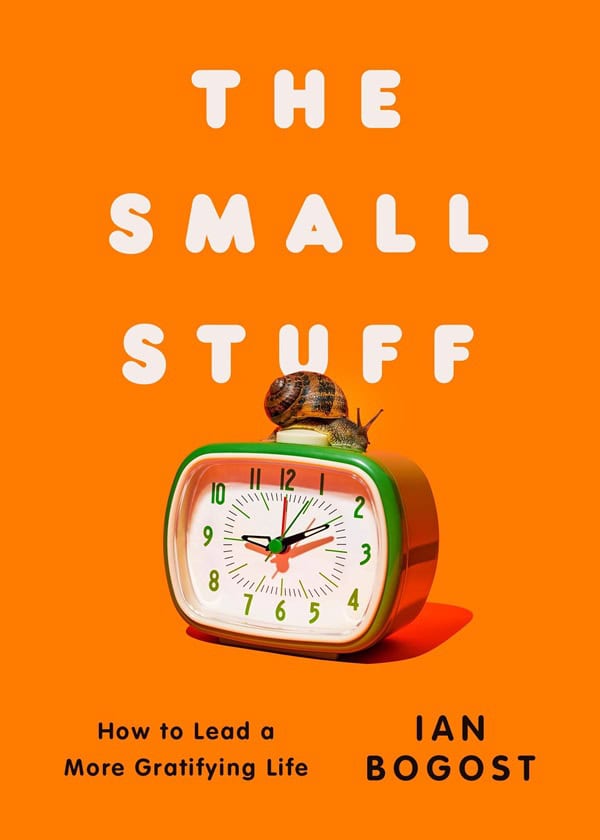
The Small Stuff. (Atria Books)
What’s your advice for people having trouble finding gratification in the small stuff?
If you just linger a little longer in any moment you’re in, then you can kind of allow yourself to find it a little bit. Or allow it to make its way past that membrane that’s resistant to it. And that exercise of grounding — of just like feeling yourself in the world and against the floor — is one example of lingering in a moment.
But yeah, extending the moment just slightly longer is extremely grounding. It’s like a way to let the sensations happen a little more.
That’s a good tip.
I’m doing this newsletter for The Atlantic. It’s kind of in the genre of this book. And I was working on this installment where I went to a state park in California with a redwood forest. I was just watching people.
It was incredible because it’s all these redwoods. And people don’t know what to do. They go there, and they’re like, “OK, we’re here. We were supposed to come and see the redwoods and be inspired by their awesomeness, but how do we do it? What do we do now?” They’re like, “Do we talk? Should we whisper?” They literally don’t know what to do.
They haven’t practiced with ordinary moments.
Like, suddenly I’m going to go in nature and be present with it. How? Unless you’re present with your Diet Coke can, how would you know how to be present with the redwoods?
There’s like a direct line to draw between me crinkling this Diet Coke can and being with the redwoods. And then when you do draw that line, it’s really overwhelming. Being in nature now for me is like very, very intense in a way that it didn’t used to be — like overwhelming in a sublime kind of way.
Since writing the book?
Yeah. Because I find that now that I take sensation seriously all the time, it’s like dialing it up. If you dial [sitting on a patio] up to 10, and then you go to a place where it really is already pretty cranked, then suddenly you’re like, “Oh no, I need to turn this down a little bit.”
There are certain secrets that only a place like the redwoods can unlock, but not that many. Being outside in the yard is, I don’t know, 75 percent of it.
And I do think, as bananas as it might sound, that the more you learn to exercise that muscle of just accepting the gratifying feeling of sensory life in any context, then the more intense and the better you are at doing it in the natural world, in the outdoors.
So if people are exploring the outdoors, how do they apply some of these ideas from your book?
The first thing for me is, I’m a reasonably diverse kind of person. I’m not a hardcore mountain biker or rock climber. I think maybe that’s the first thing that I’m not thrilled with is the idea that there are outdoors people and then there are other kinds of people. It’s not really a defining feature of an individual to be in the physical world outside of structures. That’s just part of what it means to be human.
You’re doing outdoor stuff all the time. You’re walking between your car and Walmart, and you’re outdoors. Yeah, it’s different from going to the Henry Cowell State Park in California and seeing the redwoods or riding your bike on a green trail, but you’re always outdoors when you’re outdoors. And learning how to be outdoors when you’re not extremely outdoors, that seems like a really interesting space to me.
In other words, be interested in everything in the outdoors, even the small things.
I go for walks a few times a day, and the streets are trashed around here lately [due to the 2025 tornado], and it’s just kind of interesting to be in that.
Like, everything is always changing. The leaves change in the seasons. Or today the temperature feels warmer than it did yesterday, or the breeze feels a certain way, or the petrichor smell of the rain today — I think that all of those little things should count as outdoor living, and that’s sort of like the place where more of us can meet up.
Rather than, like, “I’m either an extremist or I’m not interested.” Like, I don’t think outdoorsiness should be a property you put on your Tinder profile or something. It’s not really a property of your personality, or it should not be, to live a life outside of structures. That’s just human life. And that feels radical to me. It’s a radical idea, I think.
Many people do define themselves this way. “I’m a hiker.” “I’m a paddler.”
And so much of that is about your identity. It’s like, “This is who I am,” or “I’m improving myself,” or “I’m accomplishing something.” “I’m going to climb that bigger mountain.”
And then you see a kid just sort of scurry up a rock in the park or something, and they’re not thinking like, “Well, there’s a bigger rock.” They’re just like, “Rock. What is it like to engage with a rock?”
But I think it’s super easy to [engage with the outdoors]. It’s about noticing the feel of my feet in different shoes against different surfaces. That’s interesting. Like, the street to the south of us has all this gravel on the pavement for some reason. I don’t know why. It was there before the [2025] storm even. You know that sound of walking on a gravel surface?
[Feeling that gravel] is not about improving your life or about exercise or about rejecting consumerism or something. It’s just like, “Well, this is what my feet sound like on gravel.” And if you can’t do that, I don’t know how you do the El Capitan stuff.
And I sort of wonder, if what you want is to be more outdoorsy, then you start with the gravel. If you can take that as seriously as the mountain, then you’re in a good place.
Like, if you can’t be interested in gravel, then how are you going to go do bouldering or whatever it is? And maybe even-ing out that attitude would do us all well.
Because right now it’s very striated, very classist, like there are outdoor people and not, or like you’re not outdoors enough for me, or like, can you keep up with me on this hike? Do you have the right equipment and gear and garments?
And that’s not really what it’s about. That’s not really where the action is. I mean, the action is also there, but it’s more in those smaller moments.
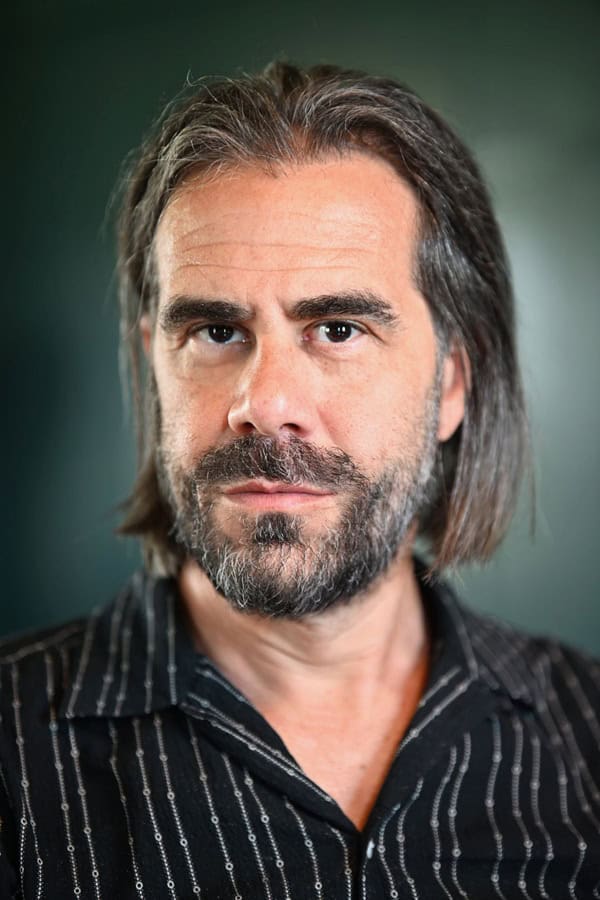
Ian Bogost. (Courtesy of Ian Bogost)
Any other things you’ve been thinking about in terms of the outdoors?
The natural world is fiction. We don’t live in a natural or artificial environment. We live in a completely hybridized environment.
The fact that you can get to Yosemite in the first place indicates how hybridized it is. I have to get on an airplane and then in a car. And then when I get there, it’s been tamed and domesticated, and I know where to go and where not to go. There are guides and trails and ropes and things like that.
And we’re always living in this hybrid of the natural and the artificial or the natural and the cultural world. If we remember that, it’s a lot less guilt, but also a lot less haughtiness about it.
There’s nothing to escape. It’s just life, and there are different versions of it.
In your book, it seems like you’re also encouraging adults to see the world as kids do.
Kids have this incredible wisdom that comes from open-mindedness, from not having already made decisions about what’s important or unimportant. And sometimes if we just follow their lead, we would be better off. You give kids a cardboard box, and they’ll invent a whole world around it. And then as adults, we need manufactured goods and organized spaces and all of that.
The thing about the childlike attitude isn’t that it’s about being childish. It’s about being curious and open, and if we all had more curiosity and receptivity, we would be much better off. So I think curiosity and receptivity above all are worth borrowing or reclaiming from childhood.
It’s not even really about taking more time either, because I’m not saying you need to like borrow time from elsewhere. You just need to reconfigure the way you orient toward the time you already have. So that whatever’s happening to you has this additional register of curiosity and gratification and openness and receptivity.
How do you do that? How do you become more curious and open and receptive?
Maybe embracing ignorance is one way to do it. I have certainly found in my life when I’ve been forced to face my own ignorance — like when my pool guy, Kevin, teaches me something about tiles and their relationship to freeze-thaw cycles — I learn something.
And by learning it, I’m now much more deeply engaged with that particular weird corner of the physical world. And so the more curious you are, the more you learn, and that takes care of the receptivity problem.
In terms of your own time in the outdoors, do you have any favorite spots or activities?
Having Forest Park nearby is incredible. I can walk there or bike there. And [the WashU] campus is bikeable, and so in good weather, I did that a lot — before my bike got stolen anyway. For the last year, my outdoor life has been the neighborhood, and it’s just been really interesting.
And then on a weekly basis, I’m out here in the backyard. This isn’t what you’re asking, but it is my answer. I’m out here doing yard work, and that is part of my outdoor life. I take it really seriously, not just because of the satisfaction I feel in tending to and being a steward of this specific corner of the environment, but to understand it better and to connect with it.
And when we transplant these boxwoods and they don’t succeed, then I learn something. And when they do succeed, then I learn something. And we had this whole native plant garden that we put in after the storm, which I’ve been learning about from the folks who designed it.
Nice.
Again, these are owned trappings of my private life on the piece of land that I possess. It doesn’t feel right to talk about them as outdoors person-ship.
But then to me, by doing that work every day, just walking in the neighborhood, then when I go to Half Moon Bay or Henry Cowell State Park to engage with nature in the way that I think people mean when they say the outdoors, I feel much, much more connected to it.
And I don’t see it as a punctuation mark, as a goal. It’s more just like those are interesting moments that are constant with the rest of my life in a different way.
I see.
I guess I’ve been trying to deconstruct the indoor-outdoor dichotomy to be a little more academic about it. And again, I don’t think it’s the answer that people want to hear when they ask the question you asked, but when the weather’s nice in the spring and I start doing breakfast out on the porch, I feel like that pays dividends. And I’ve started to feel comfortable in my skin.
A few years ago, if you’d asked me about my outdoor activities, I would’ve been like, “Oh man, you got me. I’m not really an outdoors person. I don’t have a big hiking hobby. I don’t go off into the Ozarks or down the river or whatever.” Or I used to sail when I lived in California, and that’s what I would’ve said. “Oh, if I could only go back.”
But now I’m like, “No, I live my outdoor life every day.” It’s just the unrecognized version of it. And when I get to be outside, I think I’m better at it now.
In other words, you appreciate it more?
Yeah. I just take it in better. I guess what I’ve tried to do in nature is transform my natural encounters into ordinary ones that are more like my interactions with the Diet Coke can here than they are like my interactions with the redwoods.
And that’s when I feel like they’re successful for me. It feels counterintuitive, but I feel extreme gratification and satisfaction from doing it.
I don’t know if your readers will jibe with that or anything. I think that the ordinary person, the everyperson, is struggling with this idea of who they should be or what their relationship ought to be with the outdoors if they don’t already have one — or if they don’t think they already have one. And I promise that they do.
So yeah, in that respect, it’s very ordinary, and I feel good about it. I’m not embarrassed by it.
I think a lot of our readers will connect with that.
Most people are normal people and not extremists, ultimately. And we’ve just been kind of tricked into thinking that everyone lives at the extreme, that everyone’s doing seven days a week of Zone 5 Peloton for 45 minutes, and they’re definitely not.
What do you think is the most surprising or subversive aspect of The Small Stuff?
The one that stands out to me most is the idea that being content doesn’t have to be hard, that there’s at least a kind of contentment that is easy and that there’s a surplus of it. There’s no scarcity. I think that completely goes against the grain of everything we’ve been taught to think about living a good life. I think that’s radical.
Also, I can’t believe I’m saying this, but I think that the idea that we live in a human body fundamentally and all the time — I think that’s also a radical idea because we think we live in our heads. We don’t really think we have bodies. We think that we can overcome them. We think that what matters are concepts, ideas, symbols, intangible things.
So I think that a return to the sensory physical world is radical. I think it’s counterintuitive. It’s kind of bananas that that would be radical, but I think it is.
Switching gears a bit as we wrap up: You’re also an award-winning game designer, and in one of your previous books, Play Anything, you describe how you can turn virtually any aspect of life into a game. So I’m curious: What are some games people can play in the outdoors?
Games are really good at structuring action. And you don’t even need a game. You just need some arbitrary constraints.
Like, “I’m going to spend five minutes in this natural environment.” “I’m going to go to this corner of Forest Park I’ve never been to.” “I’m going to get up really early and go to a familiar place for 30 minutes.” “I’m going to ride my bike where I usually walk.” “I’m going to jog where I usually walk.” Anything like that.
That’s what I would recommend because otherwise it becomes kind of cutesy or weird. But repetition is huge. If you can go back to something again, you almost don’t need the game because your brain and your body will be like, “OK, what’s new? What’s novel here?”
That’s what fun is to me. It’s finding novelty in familiarity. You’ve seen it all before, but there was something new.
This interview has been edited for length and clarity.
Author: Shawn Donnelly is the managing editor of Terrain.
Top image: Ian Bogost in his backyard. (Shawn Donnelly)
Leave A Comment