
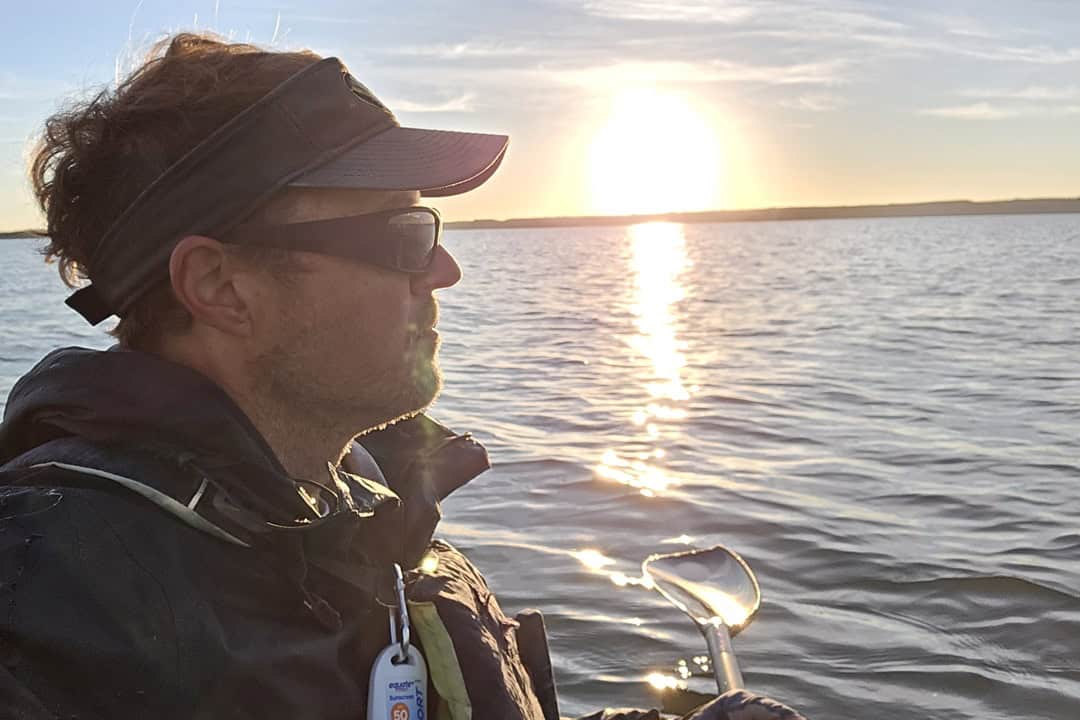
Routines and rules. That’s how Pete Larson managed a solo 2,341-mile paddle down the Missouri River. And because he stuck to those routines and rules, he not only endured the toughest moments, he also found himself chasing a record.
“When I started this journey, I never put myself in the category of going for the overall record,” says Larson, who lives in the St. Louis ’burb of Ballwin, Missouri.
Here’s the quick story of the overall record he’s speaking about. In 1980, Verlen Krueger and Steven Landick paddled the entire Missouri River in 33 days, 18 hours, and 45 minutes, a record that has stood since.
This year, Larson set his sights on a more modest goal: to best the 1999 time of Ron Severs, who completed a solo paddle down the Missouri River in 43 days.
Severs, though, got some help. Larson would not.
Preparing for the trip didn’t go as planned. In the first few months of 2026, Larson’s father-in-law died, and his wife experienced a health emergency. Then, in mid-May, his father passed away.
When Larson slid his kayak into the headwaters of the Missouri River in Three Forks, Montana, on June 1, he’d only logged a couple of hours in the 17-foot Delta kayak he was sitting in. “Which I don’t recommend to anyone ever,” he says.
Early on, he had to build endurance and adapt to the new kayak.
“My first couple days, my heart rate was like 150 to 180 [beats per minute].”
His fingers blistered, and he fought exhaustion. But two rules kept him moving forward.
Rule number 1: “Zero days were not an option,” he says, referring to a day spent not paddling at all.
Rule number 2: “Regardless of what time you got up, you had to paddle for a minimum of 12 hours.”
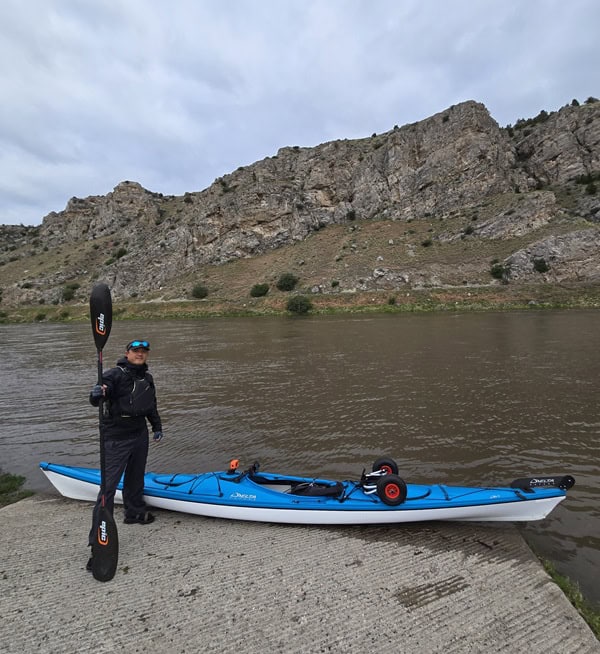
Pete Larson putting in at Three Forks, Montana. (Courtesy of Pete Larson)
Larson also settled into a routine on the water. He’d snack at 9 a.m. and 11 a.m., eat lunch at 1 p.m., snack again at 3 p.m. and 5 p.m., then stop for dinner between 7 p.m. and 8 p.m. Every day.
“That became a thing to look forward to,” Larson says. “I could just grind out 30 more minutes. And then okay, it’s 11 o’clock, you can put the paddle down for a minute, finally get a drink of water, open up the snack hatch for a beef stick or a fruit strip or a Clif Bar, and sometimes you had just that five-minute break of the paddles down, get the feeling back in the fingers for a minute, look around, see where you’re at, get the heart rate down a little bit.”
After two weeks of paddling 12 to 14 hours every day, the blisters calloused, and his heart rate settled to around 105 beats per minute. And he found a mental groove, too.
“There’s kind of a Zen state you get when you’re just covering miles,” he says.
And cover miles he did. Larson, an experienced whitewater paddler, raced through a 16.5-mile portage at Great Falls, Montana, in 5.5 hours (fueled in part by a gas station bacon cheeseburger), then got back on the water below Morony Dam (a huge hydroelectric gravity dam) and barreled through four sets of Class III rapids with just one anxious moment.
When he scouted the rapids before the trip, he thought he’d need to navigate the third set of rapids on river right. But he was totally wrong.
“It was a chute that was probably 30 feet long and had a 10-foot drop, and at the bottom was this 6-foot-plus surging wave hole — not something you want to see in a touring kayak,” Larson says.
“My whole boat went into the wave, and I came out the backside. I had a wave completely blast me in the chest and go over my head.”
A scary moment, but he was fine.
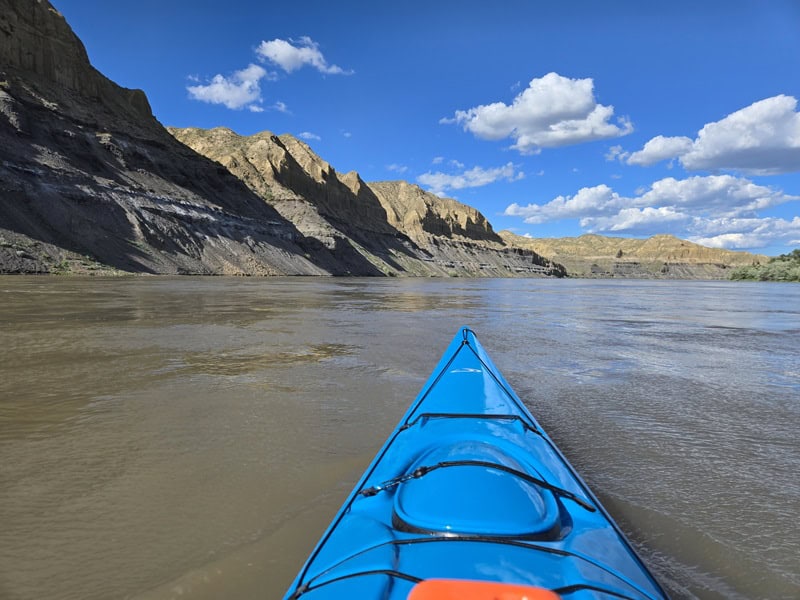
Larson paddling past the White Cliffs section of the Missouri Breaks in Montana. (Courtesy of Pete Larson)
Next, he’d have to navigate across the slack water of the upper river’s reservoirs. After a nearly snowless winter, the water levels were low.
“I wasn’t getting much of a push, scraping over sand bars constantly,” he says. “And where I expected to get 80 miles a day, I was getting 60, 65 tops.”
He fell behind schedule, which frustrated him.
Then he hit the Missouri Breaks, which meant fast-moving water. He knocked out 96 miles in one day, and optimism returned.
He zipped across the big lakes without incident — except for Lake Sharpe in South Dakota.
He made a strategic error when he crossed the lake in the middle of a storm and found himself navigating through 5-foot-tall waves in driving rain.
“I was moving along at 1 to 2 miles per hour, fighting with everything I could with 30-mile-per-hour winds in my face, waves crashing on me, couldn’t see 100 yards ahead,” he says.
“I had 3 miles of just the worst paddling ever.”
One of the skills he’s learned is setting small goals to get through a long day. That came in handy on Lake Sharpe. His thought process: “OK, I made it to that tree stump. OK, I made it to that rock I saw. OK, I made it to the next bend in the river.”
He still managed 36 miles in a grueling 14-hour day of paddling, much better than the 24 miles he’d been aiming for.
The miles flew by after that, but he still wasn’t thinking about challenging the overall record.
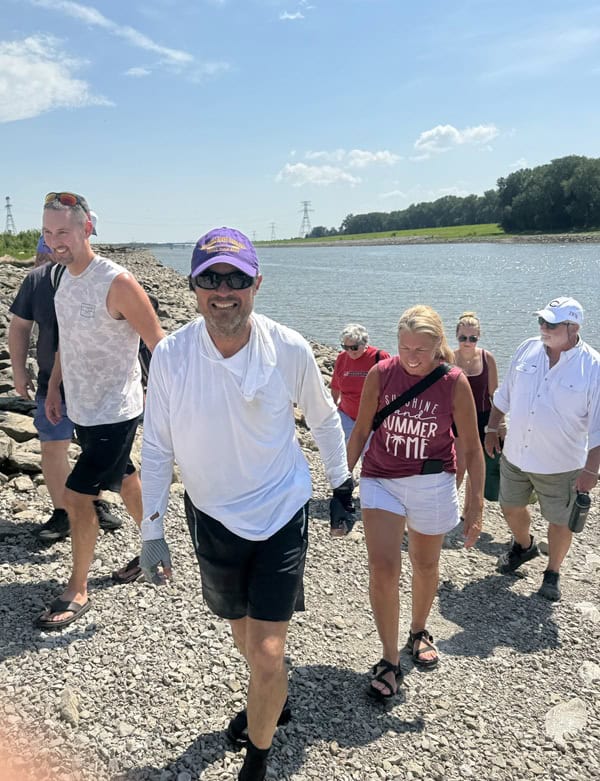
Larson at the end of his record-breaking paddle. (Courtesy of Cheri Becker)
He was 12 days out when his friend and fellow paddler Norm Miller put an idea into his head: Go for the record.
“He was the first one who believed I could do it,” says Larson. “He was watching the numbers. He’s got way more experience and knowledge of the river than anybody else living does. I responded back right away, ‘I don’t think it’s possible.’ Because I didn’t believe it at the time.
“But after two more days of paddling, I started running those numbers in my head, and I got through a couple of those last lakes. I went, you know what? I think I could actually pull this off.”
Sitting in his kayak near Yankton, South Dakota, Larson recorded a video in which he announced he would make a run for the record.
After meeting his goal of averaging 90 miles a day for 9 days, and after paddling through the night once, he pushed off from New Haven, Missouri, on July 3 for the final 82 miles.
He raised a paddle in triumph when he reached the Mississippi River near St. Louis — 32 days, 6 hours, and 7 minutes after leaving Three Forks, Montana.
He paddled on to celebrate with friends and family at a park near the Chain of Rocks Canal near Granite City, Illinois, where his trip officially ended.
What was he feeling in that moment?
“Excited to see them,” says Larson. “At the same time, completely mentally and physically exhausted.”
But thanks in part to those routines and rules, he had fought through the fatigue, rapids, and storms and broken a seemingly unbeatable record.
Note: Larson’s hold on the overall record may soon be surpassed by a four-person paddling team from Minnesota, which is currently making its way downriver and aiming to reach St. Louis in late July. Even if it does, Larson is likely to maintain the record for the fastest solo, unsupported paddle of the Missouri River for a long time.
Author: Dean Klinkenberg is an author and a contributor to Terrain.
Top image: Pete Larson on Lake Sakakawea in North Dakota. (Courtesy of Pete Larson)
Leave A Comment