
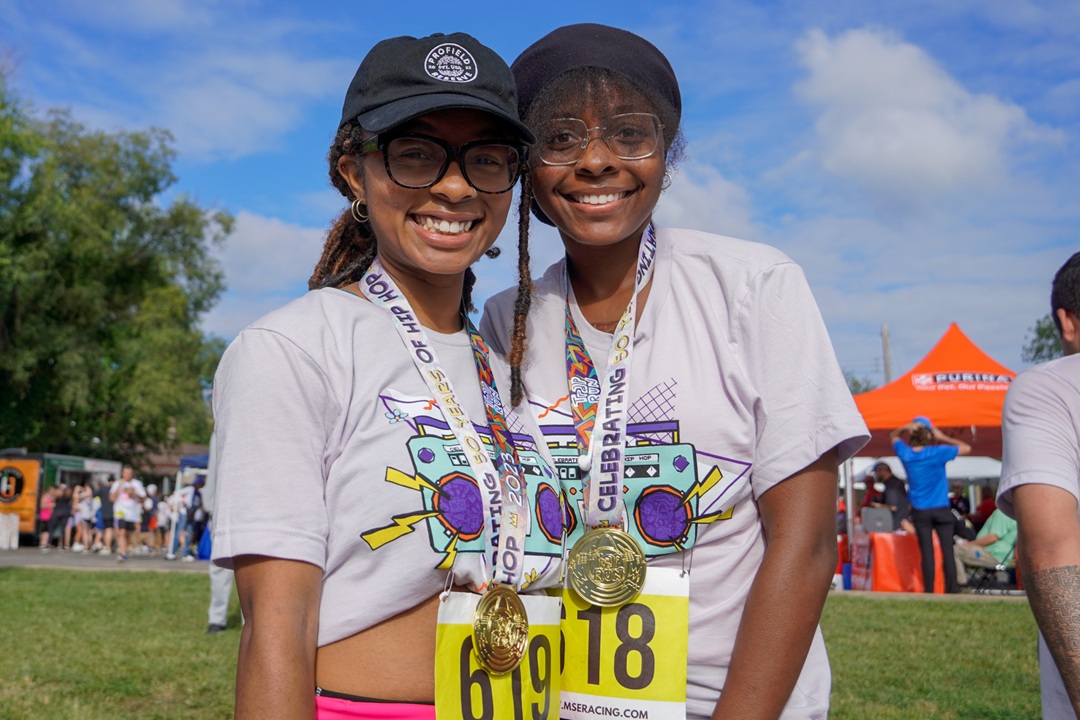
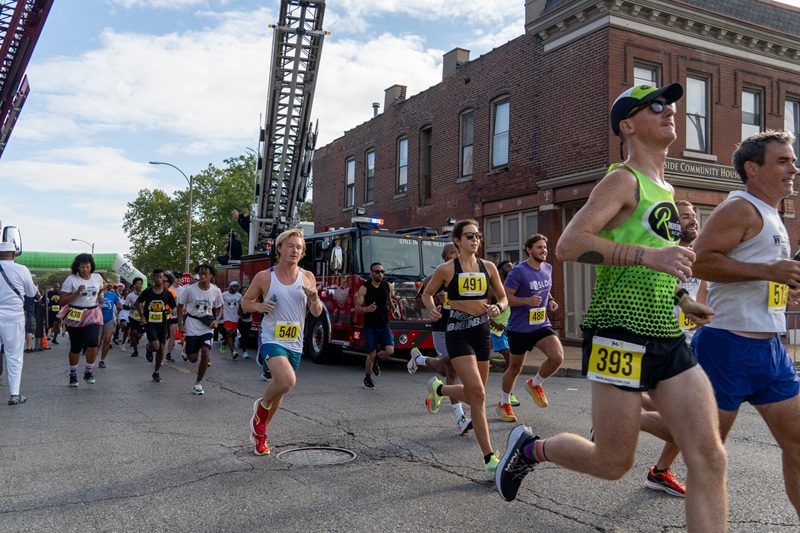
It’s a cliché to say that a race is back and better than ever, but the Northside Trap Run really is back and better than ever. Now in its eighth year, this September 6 event in North St. Louis offers much more than a simple 5K walk/run.
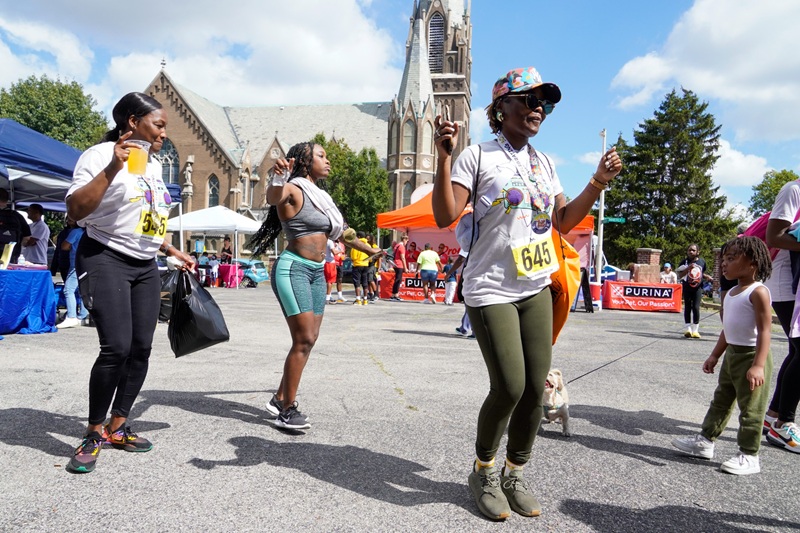
The city’s first hip-hop-themed 5K, it also boasts a 1-mile fun run, more than a dozen DJ booths along the racecourse, cheer stations, double dutch, a brass band, a yoga warmup and cooldown, local food vendors, giveaways for people and pets, a bounce house for kids and a bounce house for adults, and much more.
In short, it’s a community festival in north St. Louis (MLK Drive at Sarah Street) that also happens to have some running. For many participants, it’s a chance to visit a part of the city they don’t often explore. And for all attendees, it’s an opportunity to help bridge the so-called Delmar Divide of St. Louis.
We caught up with race co-directors Kameel Stanley and Aaron Williams to talk about this year’s event and how the race has evolved since its inception in 2018.
Do you have anything new and exciting planned for this year’s Trap Run?
Stanley: Of course! We have a bunch of new things. The first thing people will notice is that our start and finish line is in a different place. We’re going to start and finish at the corner of MLK and Sarah, right there in front of The Ville sign. Also, our festival will have an expanded footprint, and we’re extending the hours. In past years, Trap Run has been from 8 a.m. to noon. This year, it’ll be from 8 a.m. to 2 p.m. The festival will run along MLK between Sarah and Whittier. We’ll activate that entire footprint.
(Alumni Broadcast Association)
Cool. Anything else?
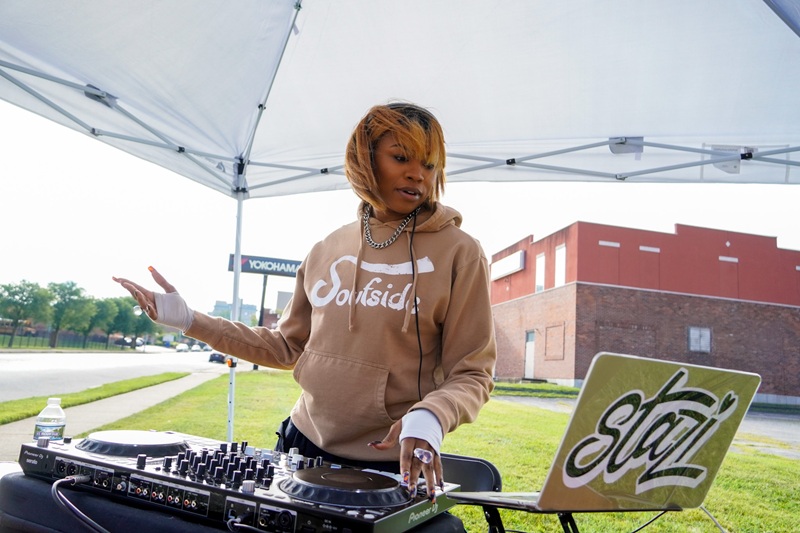
Stanley: We added more DJs. DJs are a key part of the event. That’s what makes Trap Run different than any other race in St. Louis — and, I would argue, in the country — is that we have local DJs placed along the route. This year, we’ll have at least 14 DJs.
So runners will always hear music.
Stanley: Yes. Music is such a key part of the event. (Editor’s note: The Northside Trap Run is named after trap music, a type of hip-hop music that features heavy bass and synthesized drums.) We will also have a stage with singers and a brass band.
(Alumni Broadcast Association)
That’s a lot of good stuff. Anything else planned?
Stanley: Trap Run has always been family-friendly, but this year we’re leaning into that. We’ll have two gaming trucks. We’ll have inflatables for both kids and adults.
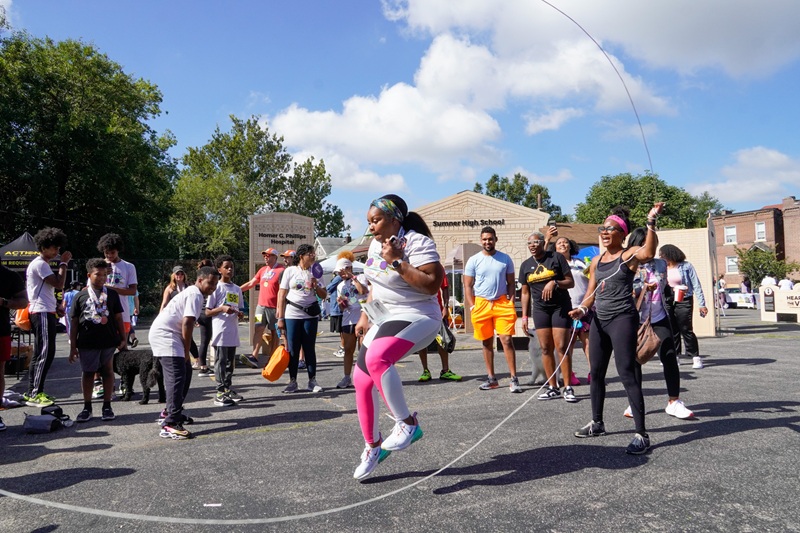
And we’ll have some things that have been a hit in the past. Black Girl Recess will be coming back. They’ll be doing line dancing and double dutch. And we’re partnering with yoga instructors from The Collective STL. They’ll lead warmup and cooldown sessions before and after the race.
You have some big-name sponsors. Will they be doing activations?
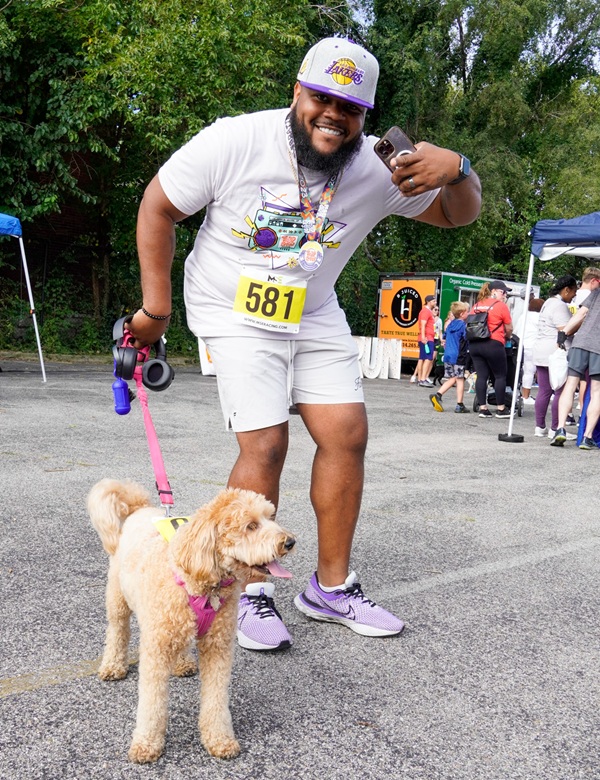
Stanley: Yes, of course! Purina is our biggest sponsor this year, and they’ll be making sure that we have stuff for people and their pets. Because when I say Trap Run is family-friendly, that includes all members of the family, even if they’re furry.
So people can bring their dogs and run with their dogs, as long as they’re on a leash. Purina will be providing things like leashes, dog tags, water bowls — things that people actually need if they’re a pet owner — as well as fun activities.
(Alumni Broadcast Association)
Who are some of your other sponsors?
Stanley: Civil Life is one of our mainstay partners and sponsors. They make sure that we have beer. We will have Mighty Kind (CBD seltzer). Gourmet Soul will be providing brunch-type food. We’ll have B Juiced. Trap Run has never been just a 5K. We really try to provide a lot for the community to come out, have a good time, and celebrate.
And I think especially in light of the year that we’ve had, we’re going to be very intentional about having things specifically for residents for them to be able to take a load off. Our theme this year is Run to the Future.
So we will be encouraging people to come run and hang out at the festival, but we also want to give people space as a community to reflect on what they want their future to be like individually and for the neighborhood.
(Alumni Broadcast Association)
Williams: Going along with that theme, we’ll have a pop-up activation creating things like a park-lit crosswalk. There’s going to be street art. Kids will get to make seed bombs (small balls of soil and seeds designed to be thrown onto land to promote plant growth).
We’ll also have an adult bounce house, which I’m very excited for. You can do the gladiator-style jousting where you knock somebody off a stand. And we’ll have a pop-up lounge for people to come, relax, and share their thoughts on their vision for Black futures — sort of going with the theme of Run to the Future, imagining Black futures.
How has the tornado in May affected this year’s Trap Run? Was any part of the course damaged by the tornado?
Williams: There was no tornado damage along the course route specifically. We were right on the edge. We’re putting the race barriers up right next to where there’s still debris from Harlem Tap Room. Fortunately, the Tina Turner mural and nearby storefronts were safe from the storm.
Stanley: One thing that I think the storm did do is make us more determined. It made us more determined to make sure that this year’s Trap Run was the biggest and best that we could make it.

(Alumni Broadcast Association)
How has the Trap Run grown and evolved since you started it in 2018?
Stanley: It has definitely evolved. It hasn’t been a straight line of growth because, like so many events, we were on a growth trajectory and then we took a hit after Covid and have been building back up ever since. Last year’s race saw a big growth spurt, and we expect to see more growth this year.
When we first started Trap Run, we were looking at a couple hundred people. Last year it was several hundred people. This year I think it’s realistic to crack a thousand participants.
Williams: Yeah, we’re expecting anywhere from 1,200 to 1,500 people this year, between the run and the festival.
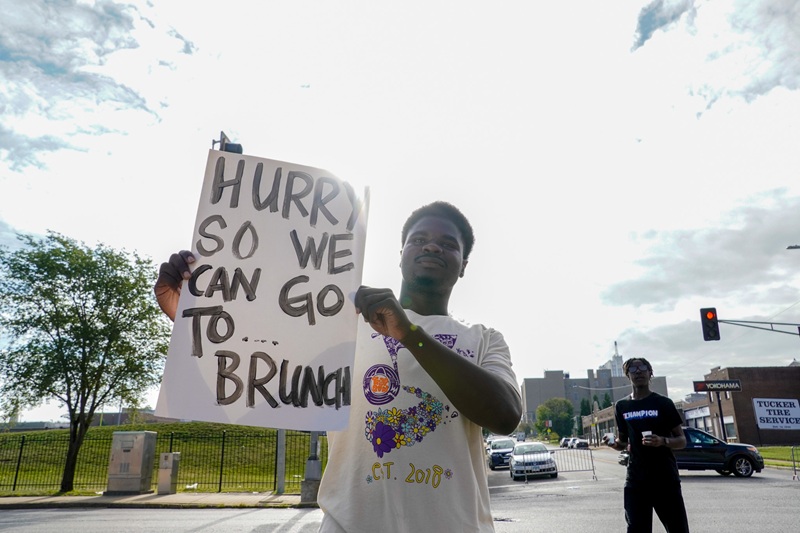
Stanley: I think our cheer station competition is indicative of another type of evolution. When we first started Trap Run, we just had to figure out how to make the race happen. And then we got to a point where we thought, How do we raise money and also keep it creative? The cheer station competition is an example of how we give back.
Nonprofits can participate in the cheer stations located at the DJ booths. Whoever wins the cheer station competition, which is voted on by the runners after the race — they decide who had the hypest cheer section — the event committee donates $500 to that nonprofit. So that’s an evolution of this event, and I think it reflects our values.
(Alumni Broadcast Association)
Lastly, how is this event helping bridge the Delmar Divide in St. Louis?
Stanley: Bridges can’t be built without awareness, empathy, understanding — and work. And in a region like St. Louis, where many people stick to their part of town, the Trap Run acts as a catalyst to break that pattern.
We draw people from all over the region, state, and, yes, even the country. Countless participants have told us that Trap Run has changed their perception of the city and their neighbors, seeded curiosity, and built connections they otherwise wouldn’t have pursued.
(Alumni Broadcast Association)
That’s making a real impact.
Stanley: Yes. And we are very intentional about having the event in The Ville — one of the most historic communities in the country! It’s important to us to ground people in the neighborhoods we’re trying to highlight and uplift — because they too often are dismissed, suffer from disinvestment, and are forgotten despite their cultural contributions to St. Louis and the nation.
Trap Run is not your average 5K and has always been more than just a race. It dramatically lowers real and imagined barriers in St. Louis and unites those who care about any number of these things: wellness, community, health, fitness, fun, culture, civic engagement, Black futures, and neighborhood empowerment.
For more information about this year’s Northside Trap Run or to sign up for a race, go here.
Author: Shawn Donnelly is the managing editor of Terrain.
Top image: Participants in a previous Northside Trap Run. (Alumni Broadcast Association)
Leave A Comment